Tuesday, September 17, 2013

A Spider Webs Lessons of Life

Across the Fence #461


One day I noticed a large spider web in a corner of the window that overlooks the back yard. Luckily, it was on the outside of the window. With colder weather and fall approaching, spiders have been busy gathering the last mosquitoes, flies, and other winged prey.

There was a fly trapped in the web outside the window. I watched as the spider suddenly appeared from somewhere near the bottom of the web. When he reached the struggling fly, the spider began to rotate it, weaving silk strands around it. When the spider was finished, the fly was wrapped inside a silken cocoon. In all my years of observing life and nature around me, I had never seen a spider wrap a fly. He must have been full and wanted to save the fly for a later meal. It reminded me of Frodo in The Lord of the Rings when a giant spider paralized him and wrapped him in a silk cocoon. 

As I watched the spider and examined the spider’s web, I remembered Loren Eisele’s “Unexplained Universe” in which he writes about the lessons of life he learned from observing a spider web one day. As he watched how the spider reacted when he poked a pencil at the web, he realized that man does not exist in the spider’s universe. The only thing that concerned the spider was what kind of meal had become trapped in his web. He realized that like the spider, man is only concerned with those things that happen in his immediate universe.


I began thinking about Eisele’s observations and realized how true they are in my own life. The web of my life stretches out from a central point. Wherever I’m located is the center of that universe, whether it is in my house or somewhere along my travels through life. Wherever I am, is the center of the universe–at least to me. That’s not unlike the area of the web where the spider might be found. Nothing concerns the spider unless it invades the boundaries of its web. Any living creature that becomes entangled in the web will struggle to try and free itself, and the spider can sense the struggle and ventures forth to greet his prey and next meal. An inanimate object, like Loren Eisele’s pencil, will not put up a struggle and the spider will ignore it, knowing it’s not a meal.

I realize, that like the spider, we as humans, are for the most part, only concerned when something happens that will have an impact on us, or those close to us. Wars and famines in other countries are something to think about, and talk about, but the vast majority of people are not directly affected by those events. Therefore, we essentially go about our daily lives as if those events didn’t exist. 

People are starving to death all over the world every day, but I eat good and gain weight. Starving people do not exist in my universe. People suffering from diseases like AIDS are not in my universe unless it hits close to home. Until it enters the boundaries of my web, my universe, it has no affect on me. 

Drug dealing and gang related activities don’t exist in my universe. Oh, I know they exist somewhere out in the world around me. However, until I, or someone close to me, gets mugged or is robbed by a person looking for drug money, it’s not a part of my immediate universe. 

Wars don’t concern people unless they or a loved one are involved. If no one close is involved, the war doesn’t pertain to their universe or web of life.

Unlike the Vietnam War, which had an enormous affect on our family, the wars in Iraq and Afghanistan have had little, if any, direct affect on my daily life. It doesn’t have as much impact in my universe. If it suddenly touched someone close to me, and they were killed or seriously wounded, then it would become part of my universe. 

I look around me at my web of life and realize how small my universe really is. In proportion, it’s not much bigger than the web of that little spider. Not only does a very small part of the universe have a direct affect on my life, but I have very little direct affect on most of the universe. The web of life churns on and on at an increasing rate of speed and I hang onto the threads for dear life, knowing that if I let go, the web could spin away from me in the blink of an eye. 

The key to this web of life seems to be learning what affects us and what affect, hopefully positive, we can have on the universe and the people around us. The web for most of us is not very big. Like the spider, we must learn to sense what is important and what is not. Then we can react to those things that we can have some control over, and not worry about those things that we have no control over. That knowledge and understanding would make life a lot less stressful for all of us. We can learn a lot from observing a spider and its web. They have lessons to teach us about life.

*

Tuesday, September 10, 2013

Two Important September Events

Across the Fence #460


As I write this column, September has arrived. Where did the summer go? It seems like it just started. Now yellow leaves have begun to appear on one of the trees next to the house. This has been a very hot and humid week. I didn’t complain because I know I’ll be wishing for days like this when it’s way below zero and we’re blanketed with two-foot snowdrifts around our house.

This morning I’m sitting on our back deck and a gentle breeze washes over me as I write. A Hummingbird just joined me, checking out the red geraniums on the deck. In the distance a rooster is crowing, announcing the arrival of September. I’ll miss sitting here and writing during the long winter ahead. I’m hoping for a long, colorful fall season before winter makes an appearance.

When September arrives, the Vernon County Fair isn’t far behind. It’s the last fair in Wisconsin each year. By the time you read this we’ll be in the midst of the fair. It will be a very busy week. I’ll be in our Vernon Telephone Cooperative booth in the co-op building. Those will be 14+ hour days. If you’re at the fair, stop by and say hello. We can pretend we’re visiting across the fence.

If you stop by on Saturday I won’t be there. I’ve been asked to be a speaker at the 25th anniversary celebration of the Wisconsin Vietnam Veterans Tribute at The Highground near Neillsville, Wisconsin. The Highground is a 150-acre veterans memorial park on Highway 10 about three miles west of Neillsville.

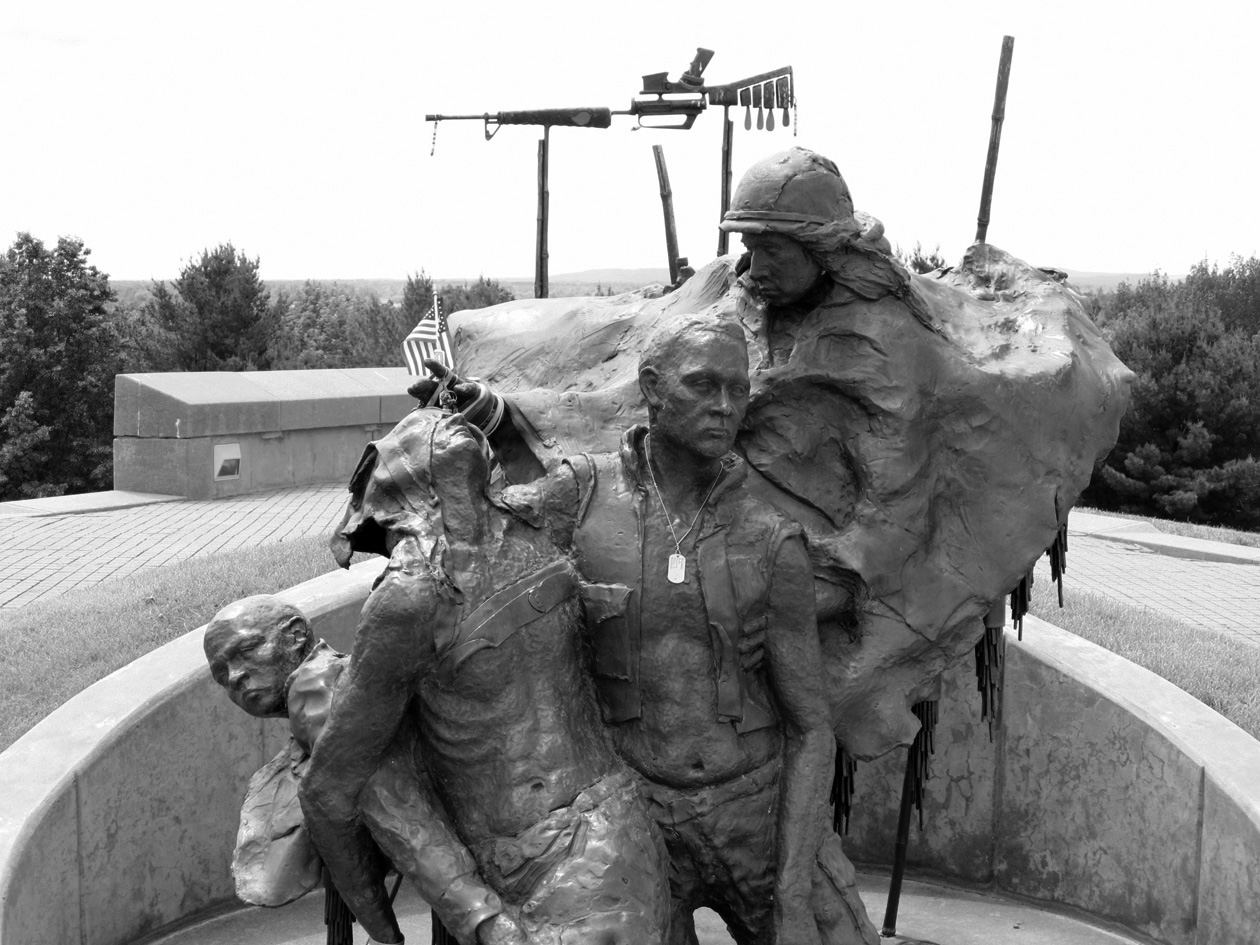
It doesn’t seem like it’s been 25 years since we had the dedication ceremony of “Fragments,” the sculpture depicting four life-size Vietnam figures. It honors all Wisconsin Vietnam veterans and lists all those who were killed and missing in action. Thousands of people crowded onto The Highground for that dedication ceremony on September 18, 1988. I was a speaker that day as we unveiled the sculpture.


Now I’ve been invited to return and speak at the 25th anniversary celebration. I couldn’t say no to that invitation, even though I should be manning our booth at the fair. I was one of the founding members of The Highground and I’ll talk about some of the early planning and struggles we had as we took on a task that was far bigger than any of us could have imagined. Many of us who were involved in the early development of the park will be returning for the 25th anniversary. We went through a lot together as we struggled to make a dream become a reality. 

When we began it was called The Wisconsin Vietnam Veterans Memorial Project, Inc. The site near Neillsville was chosen from ten sites by the board. Three sites were picked to make presentations to the board. As soon as I saw the Neillsville site I knew it was the place we wanted. If you’ve visited The Highground, you know what I mean.

Early on we decided to call it The Highground, and also decided that we needed to include ALL veterans, not just Vietnam veterans. We didn’t want anyone to feel they weren’t welcome. It became a veteran’s memorial park and now includes World War I, World War II, Korea, and Vietnam tributes. Also memorials to Gold Star families, women veterans, an earthen mound peace dove, the National Native American Vietnam Veterans Memorial, and a Persian Gulf Tribute is in the works. There’s a timber frame information/gift shop and a new learning center with a library and changing exhibits, dealing with the physical and emotional costs of war. We’ve also developed hiking trails throughout the 150-acre park.

The project was not for the feint of heart or those not willing to work. Thanks to a working board of directors and countless volunteers, the idea became a reality. Many times I headed to board meetings at Neillsville with the intention of resigning. In those early days very few people would give us the time of day, and people expected us to fail. Each time I was ready to throw in the towel something would happen that gave me hope and reminded me why this project was important. Much of that encouragement came from families who had lost a son in Vietnam. One father told me it was the first time he felt like someone cared that his son had died. Comments like that kept us going. 

After four long years of struggles and a lot of work, the Wisconsin Vietnam Veterans Tribute was finally dedicated 25 years ago. It was a great day for everyone involved. On Saturday, September 14 at 2:00 pm, many of us who were there when it was only a dream will gather together again. I won’t be surprised if the spirits of our friends, whose voices have been silenced, speak to us again as the wind makes the bamboo chimes of Fragments come alive with sound.

The Highground has become a place for everyone, veterans and non-veterans, a place where their emotional wounds can begin the healing process. Many call it a spiritual place. I know it has saved lives. That’s made all the work and struggles worth it. I invite everyone to come and be a part of this 25th anniversary.

*

Tuesday, September 3, 2013

Twilight Time In the Country

Across the Fence #459


It’s been a very hot August day, full of heat, humidity, and thankfully, a slight breeze. That breeze also traveled through the corn, making the stalks and leaves come alive with sound. The wind blowing through the trees gave a variety of sounds, depending on the type of tree.

This evening as dusk settles in, I’m sitting on our back deck, observing and listening as day turns to twilight. I’ve said before that this is my favorite time of the day. The hustle and bustle of the day slows down and the night sounds come alive.

If you’re sitting in your air-conditioned home with the windows shut tight and the TV blaring, or staring at a computer screen, you’re going to miss out on a wonderful part of the day. It was always a part of our day when I was young, but now that so many people hate to venture out of the air-conditioned comfort of their homes, it’s a part of life that’s unknown to many people.

The sun has now set and darkness is beginning to envelope the land. As light began to fade, I watched as individual trees in the grove next to the house, merged into a solid, dark mass. It reminded me that all of life is connected. It was like looking at the earth from outer space... there are no borders to separate people and countries. One large tree along the fence line, near a corner of the back yard, stands silhouetted against the darkening sky, a lonesome rebel among the other trees. I sit here peacefully alone, watching twilight emerge and pondering the mysteries of life.


The sounds of the night have taken over and the land is alive with a symphony of sound. I just left the deck and walked along the edge of the grove of trees and listened to the sounds of the night. There was a constant, loud chatter among the crickets, tree frogs, and assorted insects. I hope every person who reads this, has the opportunity to listen to nature’s evening symphony. The bass section has just been heard from as the frogs down by the pond added their voices. I thought the birds had all retired for the night, but the wonderful call of a Killdeer just greeted my ears.

There have been a lot fewer birds around this week. All the Redwing Blackbirds, Grackles, and Starlings must have packed up and headed for other places to spend the winter. On Wednesday morning I saw one Grackle with the Mourning Doves under the feeder. He must have missed the memo that it was time to move on.

Listening to this twilight chorus reminds me that we need to maintain habitat for the birds and assorted critters and insects, so these sounds don’t disappear. In recent days, two people, on separate occasions, approached me about their concern for all the trees and fence line habitat that has been destroyed. I recently wrote about my concerns in a story titled, “Call Me A Tree Hugger.”

As more and more trees and brush are destroyed, it’s changing the ecological balance of nature and we’re going to see fewer habitats for birds and wildlife. This spring the last beautiful tree on our old Smith School playground was cut down to make room for a few more plants of corn and soybeans. The Wisconsin D.O.T. destroyed the rest of the large trees at Smith School, along with all the trees and bushes on Sherpe Road, when they built the Uff da Bahn a couple years ago. Now I’ve heard that an out-of-state owner wants to cut down the trees along the old railroad bed across from Country Coon Prairie Church, in order to plant a couple more rows of corn. They’ve already removed all the fences and trees that used to separate farms and fields. Now it’s one large field where contour plowing has been discarded. The world is changing, the landscape is changing, and future generations will be the poorer for it if they can’t sit and listen to the wonderful evening symphony I’m now enjoying.

My father was a great one for planting trees and providing habitat for wildlife, not destroying it. The weeds, brush, and trees were left along the fence lines to provide places for the birds and animals to live and reproduce. We once came upon a Killdeer’s nest in a tobacco row while we were hoeing. He made sure we stayed clear of the nest and didn’t destroy it. He was a fisherman, a hunter, and a conservationist. He would not look with favor upon many of the practices that are destroying trees and wildlife habitat if he were still alive.

I pondered all these things as I sat in the dark and listened to the sounds of the night. The wind began blowing, adding the gentle rustling of leaves to the mix of sounds. The dark trees have now merged completely with the night sky that is now filled with countless stars. It’s always a beautiful sight in the dark sky in the country where few lights hinder the viewing. A shooting star just greeted me. It’s a great, relaxing way to bring the curtain down on another busy day.

*

Monday, August 26, 2013

Knowing the Land and Family Ties

Across the Fence #458


Scott Schultz wrote, “To truly know the land, a person must walk through Wisconsin pastures in the wetness of a cool June morning and allow Earth’s life to soak through shoes and jeans.”

I loved that quote and wrote it down thinking I might use it in a column one day. I hope Scott doesn’t mind. I was reminded of his words over the weekend during a Sherpe family reunion at our place. We have to thank our daughter, Amy, who took the bull by the horns and got the reunion organized. There are now cousins with young children who had never seen each other. It’s important to keep family ties, just as it’s important to keep your ties with the land.

On Friday afternoon my cousin, Mary Brumley, arrived from Madison. She is Sandy’s sister. For those of you who have been reading this column for a long time, I’ve often told stories about Sandy and how she spent every summer on the farm with us. Sandy would have loved this reunion, but cancer took her from us several years ago. Sandy and Mary are more like sisters to our family. Sandy’s daughter, Kris and family, also arrived from Colorado on Friday. It was her first trip back to Westby since my father died 13 years ago. Kris now has two children. After a wonderful Friday evening meal at Old Towne, we pointed out the farm across the road from Old Towne and explained to her children that it was their ancestral Sherpe farm. Their three times great grandfather settled there when he came from Norway. Sherpes lived there down to my father’s generation. Sandy was born there and I was almost born there. My parents had to move to another farm two months before I was born.

After leaving Old Towne, we all headed for our place on the back forty of the Sherpe farm. Kris said it was the first time her children, Hans and Addie, had ever been on a farm. This is where Scott’s words come back into the picture. Hans and Addie got to know the land by taking their shoes off and running barefoot through the grass around our yard. Then they headed toward the cornfield that borders our yard. They disappeared into the cornfield, just like ghost players disappearing into the corn in the Field of Dreams. Kris, her husband, Augie, and I visited in the yard next to the corn. The kids finally emerged from the corn just like in the movie. “Are we in Heaven?” No, you’re in Sherpeland.” Then they were off, running barefoot through the grass again, allowing the feel of the land to soak into their feet and free their spirits. 

Addie: “Are we in Heaven?” 
Howard: "No, you’re in Sherpeland.”

We who live on the land and have vast open spaces around us, too often, take it for granted. We can walk down the lane along the line fence and the early morning dew soaks our shoes and jeans just like Scott says. We can stop and watch the Monarch Butterflies as they feed among the milkweed plants. Grasshoppers dart in every direction as we walk through tall weeds. The countryside is filled with life, all waiting for us to discover it. I’m sure there are even some ticks that would like to hitch a ride with us. 

All these thoughts entered my mind as I watched the wonder and enthusiasm of the children. They wanted to explore and examine everything. The same is true for our grandson, Sean. He’s walking now. No, it’s more like running. He’s full of curiosity about life. He also loves the outdoors and explored the land around our house. He was constantly on the go during the weekend. I got worn out just watching him and the other young kids enjoying the day and the wide-open spaces of our lawn. Ah, to have that kind of energy again.

Another thing that became very apparent during the weekend is the importance of family. We are very lucky because our family has always been close and all four of us siblings get along. I’ve seen too many families that have been split apart by family feuds and bitterness. If we can’t get along within our own families how do we ever expect different countries, religions, and races to get along? I feel very fortunate that the extended Sherpe clan is very close. I think everyone had a great time getting together .

There was lots of good food too. Nobody went away hungry. As Mary said, “Auntie (my mother) would be proud.” She was a great cook and nobody ever went away hungry. The same can be said for our grandmother, Inga Sherpe. During the Great Depression she made sure people who were hurting and hungry got fed. It’s no wonder Kris came up with the slogan “Be Good To People.” It’s in her blood. As part of her business, she markets shirts and other items with that slogan that she copyrighted. She brought t-shirts for all of us and we had a family photo taken with all 26 of us, including the young kids, wearing Be Good To People t-shirts.

The Sherpe Clan

We are lucky to know the land, have great family ties, and know our roots. Our roots go deep in this rural land. Now a new generation with Sherpe blood, has also been in touch with those roots.

*      

Tuesday, August 20, 2013

Threshing Time In Amish Country

Across the Fence #457


This is a great time of year to be exploring the countryside. Vegetation is thick and lush. Wild flowers are blooming in all their glory in the ditches and along fence lines of every back road we travel. If you haven’t explored the August beauty of the countryside lately, I’d highly recommend taking some time to do it. Walk, run, ride a horse, bicycle, or motorcycle, or drive a car, truck, or tractor. It doesn’t matter what your mode of travel is. Just slow down and enjoy the sights, sounds, and smells of late summer. 

Linda and I like to drive slowly around the back roads and through the Amish country not far from where we live. The farm where my mother grew up is on Wang Ridge Road. An Amish family now owns it. Much of that area is now populated with Amish families. 

I’m very familiar with all the roads around that area because my mother, grandparents, and great grandparents all lived on farms on Wang Ridge Road. My great grandparents were Christian and Lene Wang. 

When I need to slow down from the hectic pace of life that I seem to be caught up in, I head for Amish country and back to a way of life that I remember when I was young. It’s a hard life where people work long hours doing hard, physical work. Many of you grew up on farms and know what I’m talking about. It was a simpler time, far from the high-tech communications world I now work in.

On my way to work one morning, I was coming out of Premier Co-op after buying a coffee to go, when I met an Amish man coming in. We greeted each other and then he said, “You’re Howard Sherpe.” I said I was and asked how he knew me. He said he recognized me from my picture in the paper. He reads my column every week. We had a nice visit. I told him where my mother had grown up. He knew where the farm is located. It was nice to know that people in the Amish community also read “Across the Fence.”

I find it interesting that as I write about the way life was lived when I grew up, I’m also writing about the way the Amish are living life today. This is a case where the past and the present meet and the past is still alive and relevant. It’s not just a memory. I think that’s why I love going for rides through Amish country. I can still relate to the life they’re living.


This past weekend the fields were filled with grain shocks. An old grain binder sat idle at the end of a field where row after row of shocks filled the hilltop oat field. At another farm, a young boy stood on a wagon and held the reins of a team of horses, guiding them between the rows of shocks. Men walked beside the wagon and used pitch forks to throw the grain bundles onto the wagon. Seeing the young boy helping, reminded me of myself when I was about his age.

As we drove past the barn on the farm, another wagon was being unloaded into a threshing machine. The straw was being blown through a door into the haymow of the barn. It would be used as bedding for the cows and horses. The oats was separated from the straw and was being bagged and would go into a grain bin for storage. The only missing component from my memory bank was the big steam engine belching black smoke from the smoke stack. Instead, a stationary gas engine drove the belts attached to the thrashing machine.


I could picture the women scurrying about in the kitchen preparing a hearty meal to feed the hungry thrashing crew. I could practically taste all the delicious food. That was one of the best parts of thrashing. The other event you always remember is when you were allowed to stand on the load and feed the grain bundles into the threshing machine. It was an important job. It was a “man’s” job. You had to learn not to feed the bundles too fast or they would jam up the machine. Then the operator had to stop the machine and unplug it, wasting valuable time. That could quickly get you demoted to helping the bagger, or sent back to the field loading wagons.

You can find lots of memories while driving slowly around the country roads, especially in Amish country. Notice I said driving slowly. It’s important that you slow down and be extra cautious. It would be disastrous if you came roaring over the crest of a hill and slammed into a horse-drawn buggy, or a group of children walking along the side of the road. I’ve seen many vehicles going way to fast and passing a buggy near the crest of a hill because they didn’t want to wait an extra 30 seconds to pass in safety.

A drive through the country is our chance to slow down the pace of life for just a moment and soak up the world around us. The Amish always greet us with a wave and a smile as we pass. We wave back. It’s nice to know that some of them even visit across the fence with me each week.

*

Tuesday, August 13, 2013

The Dark Haymow at Night

Across the Fence #457


Have you ever felt like something or someone was lurking in the dark shadows, waiting to attack you? Everyone seems to have had the experience at one time or another.

One place in particular was full of dark shadows for my brother, David, and me when we were young… the dark haymow at night! I’m not sure what we expected was hiding and waiting for us, but we could feel it! It was enough to send chills up our spines.

A haymow at night can be a frightening place, especially to young, fertile imaginations that grew up on stories of Trolls, Nisse, and Boogeymen.

In the winter, one of our jobs was to feed hay to the cows. But before we could feed them, we had to throw bales of hay down from the haymow… a very dark and spooky place. The sun sets early during the winter months, which means you need a flashlight to see what you’re doing. My brother and I took turns going into the haymow. The other would start feeding the hay that was thrown down the chute. We much preferred the job of feeding the cows!

If it was my turn to enter the haymow, I would take the trusty flashlight in hand, and climb up the wobbly, wooden ladder situated on the outside of the barn. It rested against a small open door in the side of the haymow. I’d crawl through the door and into the haymow where it was very dark! When the haymow was full, bales would be stacked nearly up to the cupola at the top of the barn. I climbed up a narrow shaft of bales to the top, always shining the light around and looking for any sign of trouble. Who knew what kind of scary creature might be waiting for me at the top of the shaft.

Hans Sherpe in haymow door.

The soft cooing of the pigeons roosting in the tin cupola could be heard as my presence and the flashlight disturbed their slumber. They stirred nervously, halfway between going back to sleep or taking flight.

More than once, a creature would suddenly spring to life and bound up the bales above me, making my heart skip a beat. The tail of a cat could be seen disappearing into the hay. In my wild imagination it could have been some wild animal that had found its way into the warmth of the haymow instead of just a wild barn cat!

Upon reaching the top of the bales, I went quickly to work, grabbing bales and tossing them down the hay chute. Before grabbing another bale, I’d cautiously scan every nook and corner of the barn with the flashlight, to make sure no creatures were lurking in the shadows.

Grandma Inga always told us stories about Trolls and Nisse that lived in the barns back in Norway and made their home among the hay. There was also the Boogeyman, who lived in dark places and loved to chase after young boys who had done something wrong… which we were good at doing!

I was pretty sure none of those creatures lived in our haymow… they only existed in Norway. But what if a few had stowed away on ships and made their way to America, along with our grandparents!

The flashlight shining around the haymow made all the dark shadows dance against the roof and sides of the barn, adding an eeriness and an urgency to get the job done quickly and get out of there as fast as I could. 

In my haste I had to be careful not to dislodge a bale at the edge of the chute and end up riding it to the concrete floor far below. Many a farmer had been seriously injured falling down a hay chute. It was even more dangerous as I hastily grabbed at bales in the dark. 

As soon as the last bale was thrown down the chute, I quickly made my way back down the stairway made of hay bales to the open door. A quick look behind to make sure some creature wasn’t following me, and I swung a leg out the door and onto the ladder. I quickly exited and hustled down the ladder as fast as I could before a hand could reach out from the dark doorway and pull me back in!

Safely on the ground, I turned off the flashlight, knowing I had once more cheated death and the hideous creatures that inhabited the haymow at night.

Trolls, Nisse, and Boogeymen… just figments of an overactive imagination in a young boy? Just fictional creatures in Norwegian folklore? Maybe! But there was a time in Norway when even many grownups believed they were real. Is it any wonder that a couple of young farm boys of Norwegian descent thought that maybe, just maybe, they weren’t just found in folktales, but could also be found in the dark corners of our haymow at night! 

I suspect that if our barn was still standing today, and if I climbed up in that dark haymow again, my heart would race a little faster, every little noise would take on a sinister sound, and those dark shadows would still be dancing on the walls and roof of the barn, as the creatures of the night came to life once more! 

Tuesday, August 6, 2013

A Visit To the Cemetery

Across the Fence #455


As I walk among the stones at the Coon Prairie Cemetery near Westby, it’s like taking a trip down memory lane. Some people hate cemeteries and find them dark, scary, and foreboding. I find them quiet, restful, and full of memories and history. It’s like taking a trip to a historical library. If only I could have an hour with each of them to ask questions and get their story. They all had a story to tell.

Most of these people took their stories with them when they left us, including my mother, who died 21 years ago on July 29, 1992. I wish I had sat down and had her tell me about her life. I have so many unanswered questions. 

As a person interested in genealogy and family history, I know the importance of cemeteries and what the tombstones can tell us. I also know the importance of maintaining those old stones. 

Recently two families from Norway visited their relatives in La Crosse. They wanted to see the inside of the Country Coon Prairie Church and also look through the burial records. They were trying to find the graves of some relatives who had come to America. I have a key to the church and agreed to meet them, explain the history of the early pioneer church and cemetery, and help them find the records they were looking for. 

When we met, I found out they came from the same area of Norway as my paternal Sherpe and Ostrem ancestors. We quickly discovered that I was related to all of them, including the couple from La Crosse that they were visiting. It’s a small world. We were able to find the Skaaland and Sandsmark families they were looking for in the records and located them on the cemetery map. Of course, I’m also related to those families. One of the men, Trygve Ege Olson, has written several books on family histories of Norway, and he was thrilled to find where members were buried who had come to America. I took a photo of everyone standing by the tombstone for them. 


It’s now been only a week since that visit and today I received an e-mail from him with all kinds of information on how we are related in many different family lines. He had a line going back from my grandmother, Inga (Ostrem) Sherpe, that I had come to a dead end on. As of today, that line now goes back to the 1400’s. I won’t bore you non-genealogy fanatics with the details, but it just goes to show what a simple visit to the cemetery can produce.

While they were here, they were glad to see how well maintained the cemetery was. It wasn’t neglected and overgrown with weeds. I remember how nice the Lund Cemetery at Moi, Norway was when we visited. That’s the church in the area where these relatives are from and where my Sherpe and Ostrem ancestors are buried. 

It’s a lot of work to keep a cemetery looking nice. Joe Rickey has been the caretaker of the Coon Prairie Cemetery for ten years. It’s a very large cemetery and it’s a monumental job to maintain it. Joe knows how important it is to keep the cemetery looking nice. He takes great pride in his job and it shows. The Norwegians looking for the tombstones of their relatives noticed too. They were impressed. The Coon Prairie Cemetery is on the National Register of Historic Places, along with the church building. Many of the pioneer settlers in this area are buried there.

Unfortunately, not all cemeteries are as well maintained as Coon Prairie and other cemeteries in this area. Many become neglected, built over, or moved to make way for highways and developments. Society does not always respect the dead and their resting places. Look at what the early settlers did to many of the Indian mounds. They are long gone. Luckily, most mounds are now protected and can’t be destroyed.

It also bothers me when I hear about vandalism in cemeteries. Many older tombstones can never be replaced or repaired when they’re knocked over and broken. I find it hard to understand that kind of destructiveness. It’s very disturbing and hurtful to those people whose ancestor’s graves have been desecrated. I once heard the reason some people destroyed numerous tombstones is that they were bored. That to me is very sad. Perhaps that boredom could be alleviated if they had been sentenced to help maintain a cemetery for the summer months. I would hope they would gain a better appreciation for what’s there and how hurtful their actions can be.

As I stand in the Coon Prairie Cemetery, I can see where two great, great grandparents are buried. To my right are my paternal great grandparents. Off to the left, are my maternal great grandparents. Near the back fence are my paternal grandparents. As I walk down the lane to the right, I find my maternal grandparents. Farther along, I come to the new part of the cemetery. There I find my parents and three sets of uncles and aunts. My relatives who rest here could fill another column. That’s a lot of ancestral history in one cemetery. It’s why maintaining them is important to so many people. You can see why I find them quiet, restful, and full of memories and history.

*