Tuesday, August 12, 2014

Prairie Ghosts and Root Beer Stands

Across the Fence #508

We had our Hanson cousin’s reunion over the weekend. We are the grandchildren of Oscar and Julia Hanson. When we were growing up, most of us lived within three miles of each other, except for our Indianapolis Hanson cousins. The rest of us were together all the time; for every birthday and every holiday. Now we’re scattered to the four winds, and seldom get to see each other. It was great to spend some time together again, along with kids and grandkids. One scary thought was brought up; at least it’s scary for me. I’m the oldest person at these reunions now. Uff da ney! 

Some of us were talking about how seldom we went out to eat when we were young. It’s not like today when people eat out more than they eat at home. A big outing for all of us was going to the root beer stand.

It was always a treat to go there on a summer evening. It was a reward after working all day and we looked forward to it. The whole family piled into the car and headed for the local drive-in. There was the Wayside Drive-in between Westby and Viroqua, and later there was Perk’s Drive-in on the north edge of Westby. 

When we pulled in, a pretty car-hop in shorts would come to the car and take our order. It seems like we always ordered the same thing, a hot dog and a mug of root beer. Soon she returned with a tray full of cold, frosted glasses of root beer, which she fastened to the open window of the car. I always marveled at how they could balance those trays full of food without dropping them. Our father handed out the mugs and hot dogs and we’d sit there watching the people come and go while enjoying a hot dog and washing it down with a cool root beer. I can taste that hot dog now, as I write about it. It was really a treat when I found out about chili dogs. Think I’ll have to find a root beer stand and order one after I finish this story. 

When we were very young, we had to drink a “baby beer.” I think they came free when you ordered some food with it. When we got older we sat in the back seat and kept an eye on the city kids sitting at the picnic tables alongside the drive-in.

I envied them being able to walk downtown by themselves and not have to be driven to the drive-in by their parents. They were all laughing and having a good time. The boys would be fooling around, trying to impress the girls, but I thought they looked stupid. I think I was just jealous of them. Sometimes I’d recognize some of the girls from my Sunday School class. I hoped they wouldn’t see me sitting in the car with my parents, and I’d slouch down in the back seat of the car so they wouldn’t see me.


As kids, our only mode of transportation on the farm was the bicycle. I guess we could have pedaled our bikes into town to the root beer stand, but we never did. My bike was an old one-speed with fat, balloon tires. The one speed being, as fast as I could pedal it. It was a used Schwinn that Dad bought for $5.00. It was a big, heavy, green machine. The area from the handle bars back to the seat post was enclosed and at one time there was a horn that was supposed to sound when you pressed a button on the side of that panel. I can’t remember it ever working as long as I had the bike. The word Schwinn was written on each side of the panels. It had a headlamp, that at one time had also worked, but I don’t remember the light ever working either. There was a seat rack over the back tire, that was handy for carrying someone when riding double. The balloon tires were great for gravel roads and back pasture cow paths. It had only one speed of course, and to stop the bike, you applied the brakes by reversing the pedaling motion. I thought it was the best bike in the whole world and I could go like the wind over the gravel roads. There were very few places we couldn’t go with our old bikes. 

When our friends rode their bikes with us, we envisioned ourselves as tough Hell’s Angels, roaring down the road on our Harleys. We put baseball cards in the spokes, fastened with clothes pins to make a motor noise. We had some great imaginations. Unfortunately, some of those cards would be worth good money today if we still had them. This was back during the days when the Milwaukee Braves had some great players. 

At least it provided us with some fun adventures as we roamed the countryside as the Prairie Ghosts on our old, clunky bikes, disguised as Harleys. All young kids need a secret club, even farm kids, and we formed the Prairie Ghosts. If we’d been smart, we’d have ridden to the root beer stand and recruited some girls to join our club and ride with us. Darn, too soon old and too late smart!


*

Tuesday, August 5, 2014

Fun Times On Hot Summer Nights

Across the Fence #507

Hot summer nights, filled with blinking fireflies, brings back memories of summers long ago when our limited rural world became a wonderful playground for us after the sun went down.

Summertime for farm kids wasn’t filled with baseball games, swimming lessons, or going away to summer camps. Our days were filled with work and chores from the time we were old enough to carry a pail, feed animals, and wield a hoe in the tobacco field and garden. Farm kids learned early in life how to work. We didn’t have a choice. It was the only life we knew and all our friends had to work too, so it was the norm for us.


Feeding chickens: Sandra, David, and Howard (holding rooster)

But after the evening chores and milking were done, it was time to relax. We often sat outside on the lawn under the big maple trees. We’d sprawl out in the cool grass while Ma, Dad, and Grandma Inga sat at an old picnic table or on lawn chairs. It was cooler outside than in the house on hot, humid days, and that’s where we experienced the magic of summer evenings.

If there was a breeze, the sound of the windmill creaking and groaning was background noise. As darkness descended around us, the fireflies came alive, their blinking lights punctuating the darkness. We always had to capture a few in mason jars with air holes punched in the lids to let air in. Then we had our own lanterns as they lit up the jar. The cricket symphony soon joined the creaking of the windmill, and a frog chorus could be heard somewhere off in the distance in the direction of the pond. The doves in the cupola of the barn added their soft cooing to the night sounds as they settled in for the evening. It was a soothing, relaxing mixture of sounds.


Arden, David, and our father, Hans Sherpe

We’d lie back in the cool grass and gaze into the star-filled sky. I wondered if anyone else was out there someplace looking back at us and wondering the same thing. The mystery of the night sky fascinated me then and still does. Today we have a lot more answers about the mind-boggling size of the universe, but there are still so many unanswered questions. We still don’t know if someone is out there looking back at us from the 100-200 billion, far-off galaxies in the universe, but I’d bet we’re not alone. As we gazed at the sky in those days, hoping to spot a UFO, an occasional bat would go darting across the night sky in search of bugs and mosquitoes for supper. They weren’t extraterrestrial, but they were still a bit unsettling to us.

Summer evenings were also fun when we had company from neighbors or relatives, and when we had our monthly 4-H meetings. There was always time for some evening fun after the meeting and eating was done. While our parents sat around and visited, we headed outside to play in the dark.

There were always games of tag and hide and seek. We had lots of places to hide if you weren’t afraid of finding some dark, secluded area, where chances were, they’d never find you. One person was chosen to be “it” and a base was selected, usually a tree, where the “it” person would stand with their eyes closed and count to 50 out loud. Then they’d announce, “Here I come, ready or not.” Meanwhile everyone had scurried off into the dark in search of a hiding place. Sometimes people would hide together. That was always more fun if it was a girl you liked. When the “it” person found someone, they would run back to the base tree and if they beat the person who had been hiding, that person was out. This went on until everyone had been found or until the person who was “it” had found all the people he/she could. Then they called out, “Olly, olly oxen free,” and all those who hadn’t been found would emerge from their hiding places in the dark. Depending on the rules of the day, the first person or last person found was “it” for the next game.

I’ve read about another version of hide and seek called “Sardines.” We had never heard of that when I was young. That’s too bad, because it sounds like it would have been interesting. In this version, the person who is “it” does the hiding and everyone else counts to 50 and then they all try to find the person who is hiding. When a seeker finds the person hiding, they join them in the hiding place. Each person who finds them also hides with them, until they become packed in like a bunch of sardines, hence the name of the game. The last person to find the sardines is “it” for the next game. Now, doesn’t that sound a lot more interesting than hiding alone in the dark?

Country kids had to work, but we also had fun, especially on hot summer nights, whether we were relaxing in the cool grass, listening to the night sounds and searching the stars, or playing hide and seek in the darkness of a country night with our friends.

Just one more thing. Who’s up for a game of “Sardines” with me? 


*

Tuesday, July 29, 2014

Trying To Restore Natural Habitat

Across the Fence #506

I was sitting on the back deck the other day, enjoying the beauty and fullness of the green summer foliage around us. Majestic, puffy cumulus clouds filled the sky, all the way to the horizon. Patches of blue, the color of Robin’s eggs, were visible between the clouds, accentuating the white highlights and bluish-gray shadows of the clouds. The afternoon sun shone brightly through the breaks in those clouds. I basked in the warmth of the sun’s rays as I remembered the bitterly cold winter we had all endured not that many months ago. Summer feels good!

There was a slight breeze, but the leaves of the trees were barely moving. Then I heard the wind as it began moving through the large tree along the fenceline behind our house. It began slowly and increased in volume until it sounded like waves crashing on the shore. It was a wonderful, soothing sound. As I listened and observed the movement in the tree, I couldn’t help but wonder what our world would be like without trees.

I know I’d miss their beauty, the many changing colors in the fall, the snow-capped branches and evergreens in the winter, the magic of hoarfrost clinging to the trees, the soothing sound of leaves rustling in the wind, watching birds and squirrels build nesting places in them, seeing birds and other wildlife seek shelter there, listening to the chorus of tree frogs in the night, sitting or lying in the cooling shade on a hot, muggy summer day, attaching a rope swing to a limb, and watching children climb and play in trees as I remember the days when I did the same thing. I see how they form a windbreak barrier against winter storms, and provide a refuge, shelter, and home for wildlife, all year ‘round. Yes, trees are essential to all life.

It takes years to grow a tree to maturity, and only a few minutes to cut or bulldoze it down. We don’t have the respect and reverence for trees and nature that Native Americans had and still have. I like this quote by Chief Qwatsinas of the Nuxalk Nation. “We must protect the forests for our children, grandchildren, and children yet to be born. We must protect the forests for those who can’t speak for themselves, such as the birds, animals, fish, and trees.” Another Native saying I like says: “Nature is our mother, our home, our security, our peace, our past and our future. We should treat natural things and habitats as believers treat their temples and shrines, as sacred – to be revered and preserved in all their intricate and fragile beauty.”

Sherpe Road before the DOT destroyed all the trees.

There’s an area of land between the Uff da Bahn and Sherpe Road that’s now owned by the state. When they built the new four-lane highway and multi-use trail between Viroqua and Westby, they destroyed every bush and tree that lined both sides of Sherpe Road. Those areas were used as natural habitat for all types of birds and other wildlife. When I look at the areas that were destroyed, I see where they could have left most of the trees and brush on the east side of what is now the new location for Sherpe Road. I guess it was easier to destroy than work around them. That area is now wide open and was filled with wildflowers until they were mown down. We’d like to restore that area to again provide wildlife habitat with wildflowers, brush, and eventually trees. It would also provide a better sound barrier against the traffic noise on the Uff da Bahn. 

Trying to restore this area between Sherpe Road and the Uff da Bahn, but people keep mowing it down and destroying the habitat. 

I realize it’s state-owned and no longer our land, but hopefully the state and county won’t mow everything down and destroy the new growth. It takes a long time to grow brush and trees of any size. I doubt if I’ll see that area restored to the way it was during my lifetime. But, as the Native American quote says, we must protect areas like that for our children, grandchildren, and the children yet unborn, so they may enjoy it.

It would be great to have that area of land become a bird and wildlife refuge in the middle of humanity again, so future generations can enjoy the views, sights, and sounds, as they walk along the road. We used to enjoy seeing deer suddenly emerge from the brush and trees, the singing of birds filled the air, butterflies and bees feasted on the wildflowers, Monarch butterflies found milkweed plants that are essential for their life, wild blackberries grew along the ditches beside the road, and plum trees provided us fruit for picking and canning. That was all destroyed by the construction of the Uff da Bahn. Now we’d like to restore that natural habitat for those who come after us to enjoy. We need to be conscious of the environment in which we live so we don’t end up destroying the land, water, and air, that all the animals, fish, birds, butterflies, bees, and yes even us humans, depend on to sustain life on this very small, blue dot in a very vast universe.

I’ll leave you with this Native American proverb, “A frog does not drink up all the water of the pond in which it lives.” Such a simple statement with such a powerful and profound message for all of us to think about.


*

Tuesday, July 22, 2014

A Summer Cruise In the Pacific

Across the Fence #505


I imagine everyone has dreamed of taking an ocean cruise at some time in their life. I took one in July of 1966. My cruise wasn’t like the movies, where there are lots of girls, champagne, dancing, and all sorts of social activities. Our Social Director was the sergeant who conducted the exercise classes, better known in the Army as P.T. (Physical Torture). We also had the opportunity of attending various lectures held on deck. Actually, we were ordered to attend. These informative lessons included; booby traps, snakes, what to do if captured, and various social diseases existing in Vietnam. We received many lecture classes on “How to stay alive or go down fighting.”

That still left countless hours to fill. Once a day we scrubbed out our compartment, which occupied all of half an hour. My job was throwing the mops over the fantail of the ship and letting them drag behind the ship, getting spotlessly clean. I consider myself quite an expert on this procedure, and if ever the conversation rolls around to the fantail cleaning of mops, I’ll be able to hold my own with the best of them.

Meanwhile, back on the sun deck. Actually it was a dirty old deck with a rail to keep us from falling into the ocean and getting out of going to Vietnam. Mainly the rail was used by seasick soldiers to lean over, while heaving their guts into the water below. I was never sea-sick, but a good share of the men were at one time or other. I attributed my sea-worthiness to my good old Viking blood. 


The decks were always overcrowded with men; sitting, standing, lying, playing cards and craps, or just talking and watching the water roll by. We spent endless hours staring at the ocean and thinking our private thoughts. Every day there it was... more water. The only change was the color and height of the rolling waves. There’s something refreshing about standing by the rail with the ocean breeze and spray hitting your face. The sun rising and setting on the water was spectacular. And the water kept rolling by!

We had three meals a day. It was nothing to brag about, but we ate it. After standing in the mess line for up to an hour to get our food, we stood at chest high, long tables and shoveled it down. In rougher water, the boat rocked so you could hardly stand up. Your coffee spilled, and anything round rolled off your plate, unto the floor, and kept on going. I think every ship must have a corner where all the apples and oranges end up. A sort of Wayward Fruit Graveyard. Ah, the joys of an ocean cruise!

When the weather was bad and the water rough, walking was quite an experience. When the ship went up on a wave you were pressed downward and could hardly lift your feet. Then the ship went down between the swells and you were walking on air, in a prancing movement. Meanwhile, the latrines (heads to you Navy boys) and sleeping compartments were filled with men on their hands and knees, so sick they’d have to get better to die.

After a few days at sea the novelty wore off and the whole situation became one of boredom. We reclined on our crowded bunks, stacked four high, and read the books and magazines floating around. Inevitably, the last pages of a story had been torn out, usually because a picture of Miss Bikini of the Month was on the other side. Soon we’d read all the books and magazines, and looked at all the pictures (several times).

We wrote letters. After we’d written our folks, our girl or wife, all our friends, grandparents, aunts and uncles, we started on distant relatives and people we hadn’t seen for years. Then we could write again the next day and tell them all the thrilling happenings in our life since we last wrote.


There were endless card games. We played Dirty Clubs and Hearts for hours on our bunks. Even a penny a game adds up when you play all day. If those stakes were too small, you could always get into a high stakes poker or craps game.

There was always someone strumming a guitar with a group of GI’s singing around him, usually country western songs. From the stairwells, rose the sound of the Black guys harmonizing on blues and soul. Ray Charles is one of my favorite singers, and one group of guys let me sing along with them on some Ray Charles songs. Ricks, also a medic, was in that group. I didn’t make any points with some of the “good old boys” from down South. They let me know I shouldn’t be singin’ with those N…. I asked them if they’d worry about whether Ricks or me treated them if they got wounded. 

The closer we got to Vietnam the hotter it got and even sleeping became unbearable in the hot, crowded, bowels of the ship. We just sat around and watched each other sweat. We developed heat rashes where I didn’t know you could even get heat rashes. Tempers got short and fights broke out. We needed to get to Vietnam so everyone could start fighting the enemy instead of each other.

That was my wonderful 23-day, summer cruise in the Pacific.

View of the U.S.S. Gordon from our landing craft, as we headed for shore.
*

Tuesday, July 15, 2014

Birds Pose Questions To Ponder

Across the Fence #504

Since I retired at the end of May I’ve been walking 2-3 miles every day and trying to get back in shape. I’ve spent too many years sitting at a desk. It feels good to be doing something physical again and being able to walk up a hill without getting winded.

Walking for me is a solitary activity. It’s my time to think and let my mind wander. That’s hard to do if you’re talking to someone or listening to an iPod while walking. I’ve always preferred to exercise alone. Even when I used to run every day and cross country ski in the winter, I did those activities alone most of the time.

When I was younger, my “thinking time” was in the silo while I was throwing down silage for the cows. I’ve referred to that period of my life as “Silo Philosophy 101.” Everyone should have a quiet time each day, where you are by yourself and can meditate and think. By thinking I mean that you should be asking yourself questions about life and searching for answers. I question everything and try to figure out the hows and whys. I don’t mean questions like, “Why does it always rain when you wash your car?” Some questions just don’t have easy answers. Maybe you should have washed the car on a different day?

I have a lot more questions than I have answers. So many of them deal with life and death. Where did we come from? Why are we here? Where are we going? I don’t have blinders on when it comes to thinking about these subjects and new scientific discoveries. I once heard the phrase, “A closed mind is like a steel trap that’s rusted shut. It’s no good for anything.”

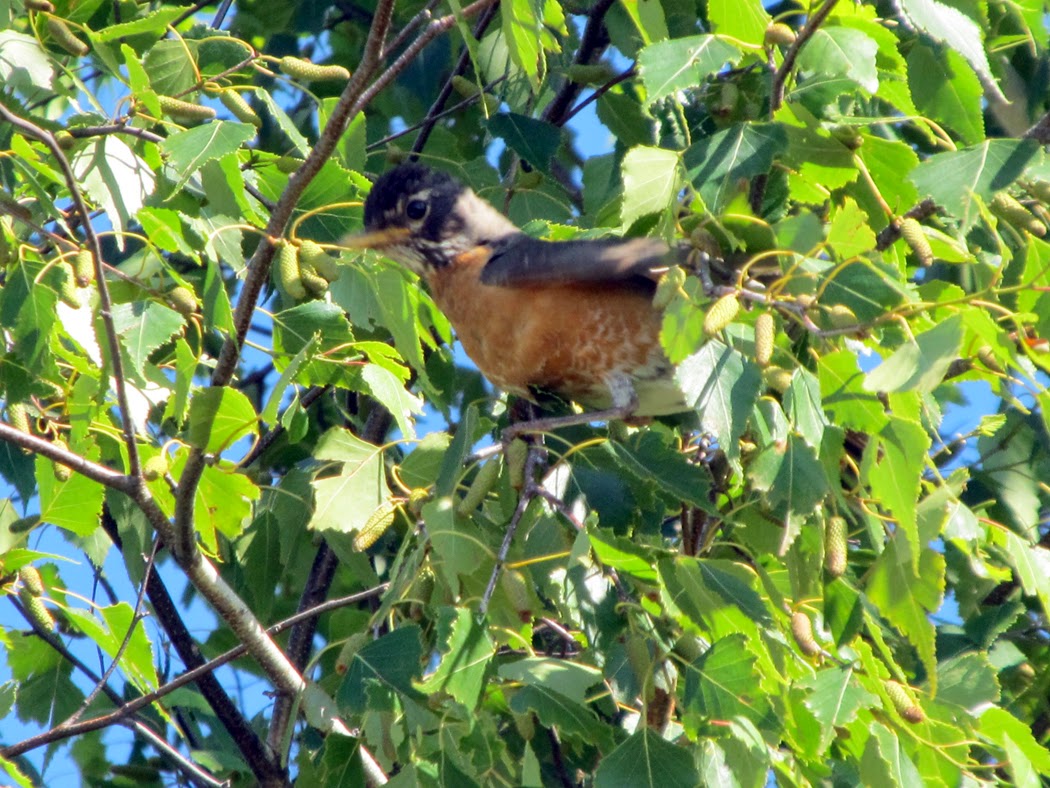
My walks often give me questions to ponder. Today while walking I came across a baby robin sitting in the middle of our country road. Two robins, who I assumed were the frantic parents, were calling excitedly as I approached. Their baby was in harm’s way, and just like a couple of human parents, they were going to protect their baby even if it meant sacrificing themselves. The closer I got to the young robin the more excited the parents became. The one was flying from branch to branch in the trees next to the road and finally began flying in circles above me and loudly scolding this monster that was approaching her baby.


I stopped briefly to examine the bird and it made no attempt to flee. I wondered if it had tried to fly and found out it wasn’t ready. Now it was stuck there in the middle of the road, at the mercy of anything that came by; a walker, a car or truck, a wandering cat, or a fellow winged carnivore looking for a meal. I continued my walk to the end of our road, turned around, and headed back. It hadn’t moved and was still in the middle of the road. I couldn’t let it sit there and be hit by a passing car. I had to move it. As I bent down and gently picked it up, it opened it’s mouth expecting food. Then it realized it was in the clutches of a giant monster and began squawking and flapping its wings. The parents were now in full panic mode and began dive-bombing me. I set it down gently in the grass on the edge of the road and continued on my way. One robin was on the road in front of me, acting like a killdeer, trying to lure me away from it’s baby. It didn’t flap its wing as if it had been hurt, like I’ve seen killdeers do, but it lowered one wing as if it was hurt. Meanwhile the other robin was circling and dive-bombing at me. They didn’t seem to appreciate that I had tried to save their baby’s life. I have no idea if the little one lived through the day or became a meal for a hungry predator. Such is life. Nature can be cruel and the story doesn’t always end, “and they lived happily ever after.”

Later in the day I heard a killdeer making a lot of noise in the road near our house. When I checked, it looked like a bird was lying in the road. I went to investigate and the killdeer that was doing all the squawking was reluctant to move at first. It appeared to be guarding and mourning the loss of it’s mate. It finally flew off, but kept circling and calling as I took the dead bird, that appeared to have been hit by a car, and put it in the ditch beside the road. It will probably become a meal for another animal or bird, as the circle of life and death continues.

In the space of a few hours, I had witnessed parents trying to protect their young baby from harm, and another bird mourning the death of it’s mate and not wanting to leave it's side. This morning when I went for my walk, a killdeer was wandering around in the road near the spot where the one was killed yesterday. Was it the mate? I don’t know, but the two incidents involving birds give me more questions to seek answers to.


Tuesday, July 8, 2014

Traveling Country Roads 101

Across the Fence #503

It’s time for a refresher course on how to travel on country roads. Many people never take time to slow down and take a leisurely ride through this glorious countryside we live in. I think most people will agree that we are in a hurry these days. The roads are filled with people trying to get from point A to point B in the shortest possible time. Our Interstate highways are racetracks. City streets are clogged with bumper to bumper traffic. That’s not the kind of road I like to be on or want to travel. It doesn’t lend itself to peaceful meanderings and wonderful discoveries.

Lets spend a few minutes and get off the fast track. Lets start by exiting the Interstate and finding a lesser traveled state highway where the posted speed limit is 55. Granted, very few people go the speed limit. They like to travel 5-10 miles an hour over the limit. That’s 75 on the Interstate and 65 on state highways. That’s way too fast to enjoy the countryside around you. 

To really explore the country you need to find a sideroad, a country road that takes you off the beaten path. Most of those roads are blacktop these days. Slow down to 35 and start noticing the scenery, the wildflowers in the ditches, the old farmhouses and barns, and watch for wildlife in the fields and hills around you. Maybe you’ll see a turtle crossing the road, deer and fawns, or cranes in a marsh. If you come across a gravel or dirt road, you’re really getting back to basics. Slow down even more, so you don’t raise too much dust. If you’re really lucky, you might come across the ultimate country road that’s more of a pathway. That’s where you have a couple of dirt ruts with grass and weeds growing between them. You need to have an adventurous spirit to start down one of those pathways because you never know where it will take you or what you might find at the end of the trail. If there are “No Trespassing” or “Private Property” signs at the entrance to a road, respect their privacy and don’t enter. Those signs are there for a reason. You don’t want to be staring down the barrel of a shotgun at the end of the road.


Traveling a country road isn’t meant to be a race. When Linda and I go for rides around the countryside, we don’t have the pedal to the metal. To enjoy country roads you need to slow down, open the windows, and turn off the radio. There’s so much to see, hear, and smell and it’s not the same with the windows rolled up tight and the air-conditioner and radio on full blast. Here in Vernon County, in the heart of the Driftless Region, going for a country drive is like riding a roller coaster. Up, down, and around you go, constantly winding back and forth around every hill and valley in the landscape. It’s hard to find a straight road in the whole driftless area, and there’s still plenty of wild country. When Linda first experienced all the wild country around here, she laughed and said if I ever wanted to get rid of her, all I’d have to do is take her for a ride and drop her off on some desolate road, and she’d never find her way back. 

All the curves and hills are another reason to slow down and enjoy the scenery. You never know what you might encounter around the next bend or over the crest of the next hill. Even so, many people are still in a hurry on country roads. When we get an impatient driver on our bumper, we find a place to pull over and let them speed on by. Or, we turn at the first sideroad we come to and hope the other car goes straight. If they turn too, we start the process all over again.


When traveling country roads we don’t have a destination in mind. We let the road and scenery determine which way we’ll go. Generally our destination is back home again, but we seldom know what roads we’ll take when we start out. That’s all part of the fun and adventure of exploring country roads.

We often ride though Amish Country. Much of the area between Bloomingdale, Cashton, and Ontario is now farmed by the Amish. It’s a great area to visit if you want to see how farming was done back when I was young. No matter how busy they are, they take time to smile and wave as we pass by. We always return their greeting. I want to make a plea to everyone who drives through areas where Amish live and work. Please slow down and be alert for buggies and people walking. You never know what you’ll meet as you come over the crest of a hill. If you’re going too fast you’ll never be able to stop in time. I see too many impatient people speeding along and taking chances by passing a horse and buggy on a hill or blind curve. A horse-pulled buggy, farm wagon, or tractor, has just as much right to a country road as my car.

The key to traveling country roads is to slow down, enjoy the scenery, listen to the chorus of the countryside, and experience the wonderful world of nature.


*

Tuesday, July 1, 2014

Skills of Our Parents and Grandparents

Across the Fence #502

Am I the only member of the card-carrying AARP generation who feels technologically challenged? I watch in wonder and frustration as kids, barely out of their diapers, maneuver their way around iPads, computers, smart phones, and TV remote controls. It won’t be long before our two-year old grandson will be showing us how to install and and use Apps and programs on our computer. 

We live in a different world, where computer technology is built into just about everything we use. It’s like when I’m trying to figure out where all the different-colored cables go and if they are input or output, and then what buttons do I push to make the darn piece of equipment work properly? We either learn how to use them or get left behind. Sometimes I feel like the train has left the station and I’m running down the track trying to catch it and pull myself aboard.

Last week we had lunch with my cousins, Julie and Gay, when they were here planting flowers on their parents and our grandparents graves. We talked about how things had changed. That got me thinking about my parents and grandparents and all the skills they had that are becoming lost today. What could they do that most of the high-tech generation has no interest in and wouldn’t have a clue how to do or where to begin? 

We all have different types of skills and expertise. What kind of skills am I talking about that our parents and grandparents had? Lets start with food and canning. How many people know how to can these days? My mother and grandmothers canned everything from vegetables and fruits to meats.

Before the first snowflakes of winter touched the ground, our large garden had been harvested, sampled, canned, and stored in the cellar of our house. The simple, wood shelves were filled with Mason jars containing everything imaginable. A bin on the damp floor was filled with potatoes and carrots. To get to our cellar, we had to go outside and lift up a slanted door in the ground, located next to the house. That led down stone steps to the dark, cool cellar. In the winter we had the job of going outside in the snow and cold, and shoveling the snow off the door before we could open it and get to the cellar. Then we could retrieve all the treasures waiting for us on those shelves. Even though Ma hadn’t asked for it, a jar of strawberry jam often looked too tempting to leave behind.


Last time I was in the cellar, I found two old jars of canned goods that remained on a shelf. The rest were busted on the floor.

So much of what we ate came out of that old cellar, thanks to Ma and Grandma Inga knowing how to can and preserve all the food we grew. They didn’t need to buy cans and jars of food off supermarket shelves as we do today. They never knew how to access a computer, but they kept us well-fed and alive because of their cooking, baking, and canning skills and knowledge. We didn’t have much money when we were young, but we never went hungry.

Ma didn’t buy chicken, fish, or many meat products from a store either. It was cheaper to kill and butcher our own. I remember catching chickens, chopping their heads off with a tobacco axe, and helping Ma singe and pluck the feathers off. Then she cut the chicken up and cooked it. Now most people, including us, go to the supermarket and get a package of chicken parts from the freezer section. Most people don’t think of how that chicken found its way to the store. We also caught fish in the Mississippi River to take home. Today, securing our food becomes much more impersonal.

Another thing I thought about was how seldom we went out to eat. Ma provided us three meals a day, plus “coffee” mid-morning and afternoon. I don’t know how she had time to do all that, plus wash the dishes, clean the house, wash all our clothes with a wringer washer, hang them out to dry, iron them, darn socks, and patch blue jeans with holes in them. Today people buy expensive jeans with the rips and holes already built-in. Ma would have been horrified if we had gone off the farm with holes in our clothes.

When I stop to think about it, I don’t know how she did all that, plus help us four kids, day after day, seven days a week, with no vacations.

When we talked about those days while having lunch, Julie mentioned that we seldom went out to eat when we were young. It was a big deal to go to the root beer stand and get a hotdog and root beer. Now I think people eat out more than they eat at home. A trip to Viroqua was a big deal and a trip to La Crosse, maybe once a year, became a real adventure.

Growing, producing, canning, preserving, and preparing the food we eat is just one of the many skills our parents and grandparents had that is fast disappearing from most people’s lives in the high-tech world we live in. My mother never operated a computer, talked on a smart phone, programmed a DVR, or drove a car, but she had skills and knowledge that were far more essential for our family to survive, and helped us become who we are today.


*