Wednesday, October 21, 2015

Corn Shocks Are Fall to Me

Across the Fence #570


Corn shocks stand like lonely sentinels, guarding the last memories of a vanishing lifestyle. A backdrop of changing colors in the woods bordering the cornfield signals the arrival of fall. A flock of geese passing overhead completes the picture as they talk among themselves. It’s fall and the harvest has begun.


The sight of corn shocks and pumpkins in a field represents what the fall season is to me, in the pictures in my mind. Today, corn shocks are as scarce as hen’s teeth around the countryside, unless you head for Amish country. We have a large Amish community within a few miles of Westby. As we drove around the area last weekend, we were once again treated to the sight of fields filled with corn shocks. It was a welcome sight and brought back memories of how farming used to be on most farms.

Today I can watch monstrous combines going through the fields around us, day and night, as they clear huge fields of soybeans in a fraction of the time it used to take. Soon they’ll be stripping the cornfields bare, shelling the corn as they go, and filling semi trucks that haul it from the fields. Today, fall harvesting is big, fast, and in many ways impersonal.

Many of you can still remember when small farms of one hundred acres, or less, were the norm. Corn shocks were not a novelty in those days. It wasn’t shocking to suddenly come across a field filled with them. What would us young Prairie Ghosts have done on Halloween if we couldn’t have tipped over a few corn shocks? I’m not saying we ever did, but there’s something about a corn shock that attracts young boys and shouts out, “Tip me over!”

Another thing I remember about fall and corn harvesting was helping dad clean up the field of corn that had escaped the corn picker. We used a curved husking peg or knife that was strapped to the palm of a heavy, leather strap that fit around our hand. We used it to rip open the husks, break off the corncob, and throw it in a wagon. In those days, nothing was wasted. Perhaps some of you can remember when you picked whole fields of corn using the husking peg and threw the ears against a “bang board” on a wagon pulled by horses. I have several husking pegs in case I ever get the urge to clear a cornfield by hand.

I also remember harvesting as being a neighborly event, with lots of good food involved. It was a time when neighbors got together and helped each other with the harvest. Meals were looked forward to and every farmer knew who the best cooks in the neighborhood were. Sometimes long tables and chairs were set up on the lawn because there wasn’t enough room in the house. The women slaved over the hot cooking stove all day preparing the meals. There were large bowls of mashed potatoes, rich gravy, big platters of meat, home-grown vegetables, pickled beets, cole slaw, home-made bread and lefse, topped off with fresh pie and steaming cups of coffee. My mother was known for her great meals and pies. No one ever went away hungry. The meals, shared by the neighbors, were a big part of the harvest. I suspect the men doing the harvesting today, and running those big combines and semis on corporate farms, are missing out on the best part of the fall harvest… the wonderful meals and neighbors working side by side as they helped each other.

When I feel the brisk winds of fall, as darkness begins to envelope the land, I remember sitting in an empty wagon at the end of the cornfield. It’s dark and cold. The stars shine brightly overhead in the clear, crisp sky. The light from the tractor makes strange, scary shadows dance among the corn stalks. The air is filled with the distinctive “putt-putt-putt” of the idling John Deere B tractor. In the distance I see the lights of the corn picker coming through the corn stalks. I hear the hum of the machine as it severs the stalks, and the continual “clunk, clunk, clunk” of ears of corn landing in the wagon box. The corn picker finally reaches us. Among the sounds and lights from the tractors and corn picker, there’s a flurry of activity as the full wagon is exchanged for the empty one. 
Throw in some snowflakes dancing in the lights, and it becomes a magical scene.
 When a wagon was full, we hauled it from the field to the corncrib, where we shoveled the corncobs into the crib. It was heavy, hard work, especially when I was younger. Now most corncribs are gone, along with one and two row corn pickers. Gravity boxes replaced the old wood wagons, and now large trucks and semis are replacing the gravity box. Those huge combines have replaced the need for neighbors to get together and help each other with the harvest.

All this mechanization has allowed farms to get bigger and the harvest go faster, with fewer people involved. But to me, fall harvest is still represented by those shocks of corn, standing tall and reminding us of another time and place, where neighbors even talked across the fence.
*

Tuesday, October 20, 2015

Coffee Boycott

Across the Fence #569


It’s been a long time since I’ve visited the Coon Ridge Family Restaurant and Truck Stop. Things were jumping as usual the other day when I stopped in. It’s located near the edge of town at the intersection where two roads cross. Each road leads to no place in particular, unless of course you live along one of those lazy country roads.
The Morning Breakfast Gang was holding court at the only round table in the restaurant, as they do every morning. They keep trying to solve the problems of the world. Most folks round’ here think it’s rather pointless, since most can’t even solve the problems in their own back yards. I can’t report that they’ve ever solved a single one of the world problems they’ve debated, but like people everywhere, they certainly have all the answers, at least in their own minds. I’ve got to admit, I’ve taken part in those debates too and put my two cents worth in. Every town needs a family diner where the locals can congregate and debate the issues of the day.

The Wednesday Breakfast Gang in Madison, back when I still lived there. Several of  them have moved on to the big round table in the Great Unknown. The rest of us have seen healthier days.

When Thoreau said the majority of men live lives of quiet desperation, he must have been thinking of the guys like me who hang out at the Coon Ridge Family Restaurant and Truck Stop. 
However, the name is a bit misleading. It’s not really a truck stop unless you count the assortment of pickup trucks parked outside on any given day of the week. Tiny Olson thought it sounded like a good name when he opened the restaurant. He always heard people say that you should eat where the truckers eat, because they know where the food is good. So he added Truck Stop to the name, thinking it would attract more people. What attracts the crowds to the restaurant isn’t the name. It’s the only restaurant in town, so it isn’t like they have a choice! 
In all the years the restaurant’s been open, no one’s ever asked Tiny where all the big rigs and truckers are. My guess is that no one really cares. They just want a place where they can swap lies and solve world problems over a fifty-cent bottomless cup of coffee. Yes, you heard me right, coffee is still only fifty cents at the Coon Ridge Family Restaurant and Truck Stop. That includes endless refills. 
About a year ago, Tiny got sick and tired of all the boys drinking up his coffee every morning and he raised the price up to seventy-five cents a cup. That still included endless refills at no charge. Well, the gang got ticked at Tiny for trying to rip them off and they all boycotted the place. They started driving down to Coon Creek and hanging out at Joe and Dot’s Diner. The coffee wasn’t near as good and the drive took twenty minutes each way on a hilly, winding road. That easily ate up much more than twenty-five cents in gas, so they certainly weren’t saving any money. But it was the principle of the thing. A determined, ornery, cheap bunch of Norwegians trying to make a point is not a group you want to be on the wrong side of. 
Word quickly spread around Coon Ridge that Tiny had raised his prices and that the Morning Breakfast Gang was boycotting the place. Loyalty to a hometown business doesn’t go very far when twenty-five cents is at stake and feathers have been ruffled. 
In the past, finding a table or booth for breakfast at the Coon Ridge Family Restaurant and Truck Stop was like looking for hen’s teeth. And Heaven forbid if some outsider stopped in and sat at the wrong table. That upset the apple cart for the rest of the day, especially if the Morning Breakfast Gang didn’t get their round table. Their icy stares at the intruding parties could have sent icicle daggers through their hearts. But during the boycott, the tables and booths sat empty except for the outsiders stopping by for breakfast on their way through Coon Ridge in search of the Northwoods. 
The boycott was driving poor Tiny out of business. After two months of everyone driving to Coon Creek to eat, Tiny waved the white dishtowel of surrender and lowered the price of coffee back to fifty cents. The war was over. He hand-printed a big sign with magic markers and hung it in his window for all to see, “Coffee–Only Fifty Cents!”
The next morning, the restaurant was overflowing again as all the regulars returned. They talked about holding out for a couple extra days just to put a little scare into Tiny and teach him a lesson or two, but with twenty-five cents involved, they didn’t see any sense in wasting more good money on bad coffee and extra gas. So the whole gang is back and holding court at the round table as usual each morning.
They still think they have all the answers to solve the problems of the world, if someone would only listen to them. But, nobody does. At least in their own minds they managed to solve a major local crisis – seventy-five cent coffee. And they won. 
It looks like the taste of victory has gone to their heads. Now the boys are talking about doing something about the high price Tiny charges for a piece of pie during their mid-afternoon coffee get-togethers. They think a dollar and a quarter for a piece of pie, free coffee included, is way too much to pay.
Stay tuned. This could get interesting.
*

Tuesday, October 6, 2015

Silo Filling

Across the Fence #567


Recently we were driving behind a tractor pulling a chopper wagon full of silage. The wind was blowing loose silage through the air, leaving a trail of it on our windshield and the road. The sweet smell of silage brought back memories of silo filling. I don't see many silos being filled these days. farming has changed. 

We were always in school when the silo fillers came to chop the corn and blow it up into the silos. We’d hurry home from school so we could get in on some of the adventure. Before we could start filling, the silo doors had to fitted into place and locked, to hold the silage in. You started at the bottom and worked your way up, securing each door as you climbed up the narrow chute. It was also fun watching the men put the blower in place and attach the pipes. They used a rope to haul the pipes up alongside the silo and hook them together. The final piece was the curved pipe that went into the silo.


When the full wagons started arriving from the cornfields, the action started. After the wagon was emptied, we used the John Deere 50 to take the empty wagon back to the field and exchange it for a full wagon.

When we got to haul the wagons from the field to the silo we thought we had been promoted to the major league. It was fun, but scary too. It was tricky pulling the big chopper wagon filled with silage alongside the blower and stopping in the right spot. 

After the wagon was in place, we pulled the silage from the back of the wagon into the auger, using curved forks. The blower then sent the silage rattling up the pipe and into the silo. That was a dangerous job. Many farmers have lost arms and legs when loose clothing got caught in the spinning augers and pulled the farmer in. It’s easy to see why farming is such a dangerous occupation. You’re always working around moving parts that can quickly entangle and harm you. Maybe it’s that sense of danger that added to the silo adventure when we were young.

As it got dark, lights from the tractors created a shadow-filled surreal world. It was dark in the silo as we climbed up the narrow chute to put in new doors and adjust the pipes. We had only a flashlight to light our way and help see what we were doing. One of our silos didn’t have a roof covering it. When you looked up, you saw a round circle of black filled with stars. It was like looking through a gigantic telescope at the evening sky. The reason we kept working after dark was that we had to get the corn in fast so the people who owned the harvesting equipment could move on to the next farm and get their corn harvested. There wasn’t any time to waste.

Now I watch huge combines going through a field taking many rows at a time, while a large truck drives alongside and the silage is blown into the truck. When the truck is full, an empty truck pulls alongside and away they go again, with hardly a pause in the action. They can clear a large field in a very short time.
The corn on the fields of the back forty behind our house, disappears faster than Rolaids at a hot chili eating contest. Times have sure changed since the days of a one-row picker pulled behind a tractor. We thought things were really changing when we saw the first two-row picker mounted on the front of a tractor. 

I don't think many farmers climb up into the silo anymore either. Now silage is stored in concrete bunkers or those long, white, plastic “worms” you see around farms.    
                           
Harvesting corn is much more efficient these days, but I still like the magical world I still see, hear, and smell that lives on in my memories as I relive those days of helping fill silo after we got home from school. Eventually the night sky was filled with stars as we continued working into the night with our only lights provided by the tractors.

Besides the silo filling, there were chores to be done and cows to be milked. David and I usually ended up with those jobs while Dad kept driving tractor and hauling wagons from the field to the silo. We would have preferred doing the driving and unloading of wagons, but we weren’t given a choice. By the time we finished milking it was time for bed. Morning came all too soon. Then it was up and help with chores before heading off to Smith School. We usually walked the mile to school along Hwy.14. We joined neighbor, Sharon Midtlien first, and then hooked up with Beverly and Donna Jasperson. The five of us walked together, to and from school, almost every day. When there was silo filling to do, we walked a lot faster, so we could help haul and unload the wagons.The smell of silage brings back a lot of memories.

*

Tuesday, September 22, 2015

Field of Dreams

Across the Fence #566

I never became the next Warren Spahn. But I didn’t let that stop me from wanting to experience the “Field of Dreams” in Dyersville, Iowa.
The movie, “Field of Dreams,” released in 1989, was an Academy Award nominee for Best Picture of the Year. There is something about the movie that has tugged at the heartstrings of millions of people. It’s a film that mixes reality with fantasy and where dreams come true. As their brochure says, “People are drawn here (to the movie site) for reasons they can’t explain.”
A line from the movie says, “If you build it they will come.” And come they do, to Heaven… I mean Iowa. They “Go the distance.”
In September 2005, Linda, our daughter Amy, and I went the distance from Madison to Dyersville. Our son, Erik wasn’t able to go with. For reasons I can’t explain either, we wanted to experience the Field of Dreams.

Amy and Howard by Field of Dreams house.

There’s a magic that begins as soon as you turn into the driveway and see the familiar white house and the baseball diamond with the cornfield at the edge of the outfield. You half expect the Ghost Team to suddenly emerge from the corn.
I couldn’t take a trip to the Field of Dreams without three essential items… a bat, a ball, and a glove. Not just any bat, ball, and glove, but some real antiques.
Let’s take the baseball first. It’s just a plain old scruffy baseball, but I’ve had it for years. 
My left-handed Gil McDougald glove is old… downright ancient, almost as old as I am. I got it in grade school and it’s the only glove I’ve ever had. The padding is pretty much worn out but it’s still functional. It saw action in countless ballgames at Smith School and 4-H softball games with the Seas Branch Smithies. It’s the same glove I used during my famous, or is that infamous, pitching debut in Westby. If you read my story, “The Next Warren Spahn,” you know I threw one strike… unfortunately it went for a home run! Yes, that old glove has quite a history and it had to make the trip to the Field of Dreams. 
And then there’s my old Louisville Slugger… the bat that almost got away. I’ve also had that bat since grade school. It still has black tape wrapped around the handle for a better grip. I wonder if that would be considered legal in this day of “steroid baseball?”
As I mentioned, I almost lost my old bat. It was the day of the auction after our parents died, a cold, rainy, miserable August day. I had set three old bats aside that weren’t being sold. However, someone had thrown them on a wagon. We were pulling another wagon toward the shed, where the auction was being conducted out of the rain, when I saw the auctioneer, Gary Olerud, hold up the three bats. I panicked, ran to the shed, and waved my hands frantically to place a bid. Thank heavens there was little interest in the old, wooden bats. I got all three for $2.00 and breathed a sigh of relief. My Louisville Slugger was saved and also made the trip to Dyersville with us.
After we arrived, we wandered around the grounds. Several people were playing catch in the infield so we headed to right field.
I had to use all the famous lines from the movie, so I asked Amy, “Do you want to have a catch?” We played catch in the outfield, next to the cornfield for a while. Then Linda and I had a catch! 
Of course we had to reach into the cornfield, then jerk our hand back, and chuckle like James Earl Jones did in the movie. Then we walked into the cornfield and disappeared, just like he and the Ghost Players did. Luckily we were able to reappear again. I won’t tell you what we experienced in the cornfield. You’ll have to go there and find out for yourself.

Howard sitting where James Earl Jones sat in the movie.

We sat on the wood bleachers, on a beautiful fall afternoon, and watched families playing ball together, having a catch, and hitting the ball. I sat on the end of the lower bleacher where James Earl Jones sat when he uttered his famous lines… “The one constant through all the years, Ray, has been baseball. America has rolled by like an army of steamrollers. It’s been erased like a blackboard, rebuilt, and erased again. But baseball has marked the time. This field, this game, is a part of our past, Ray. It reminds us of all that once was good, and it could be again. Ohhhhhhhh, people will come, Ray. People will most definitely come.”
Yes, people do come, just as we did. They come to experience some of the magic of a simpler time, a time when parents and children had a catch together; when they sat on simple wood bleachers and watched the local team play ball. They come to experience the magic of walking into the cornfield. They come to experience reality and fantasy all rolled into one. They bring their old bats and gloves and use muscles they had forgotten about. 
For a few magic moments they are kids again; they have a catch with their kids; they swing old bats and hit old baseballs. Yes, I even connected on a pitch with my old Louisville Slugger.
Was it Heaven? No, it was The Field of Dreams in Dyersville, Iowa, but for a moment in time, it was as close to Heaven as you can get, and life was good… life was very good

*

Monday, September 14, 2015

Labor Day Meant Tobacco Harvest

Across the Fence #565


It’s Labor Day weekend as I write this. When I think of Labor Day, I think of tobacco harvest. When other families headed for lakes and campgrounds for the 3-day weekend, our family headed for the tobacco fields. We raised up to 12 acres of tobacco for many years. We couldn’t harvest all that tobacco by ourselves, so Dad always hired extra help. I remember they get paid one dollar an hour, plus dinner and coffee mid-morning and mid-afternoon. Depending on how many hours they worked, that was only $8-$10 per day. We didn't get paid anything for helping harvest at home. Dad said, “You get your room and board.” We liked it when our tobacco was all in the shed and we could help neighbors harvest their tobacco. People liked to hire us because they knew we were experienced at harvesting tobacco and weren’t afraid to work. When we worked for neighbors at least we got paid. That was the only time we made any money.

Even after we were off the farm, married, and had our own jobs, we were expected to come home to the farm over the three-day Labor Day weekend to help harvest tobacco. That was tough because I had a desk job, five-days a week. It certainly didn't prepare me for tobacco harvest. That was hard work even when you were in shape from working on the farm everyday all summer. I really dreaded Labor Day and tobacco harvest in those days.


I usually ended up hauling tobacco from the field and hanging it in the shed. One year when it was really hot and humid, I got heat exhaustion and almost fell out of the peak. We were hauling with two wagons and Dad decided  we'd hang the entire peak before going back out to the field. We were hanging in a six-bent shed and I had the peak almost filled when I began to feel weak and dizzy. It was a very high shed and it was really hot up there. I was sweating bullets as the saying goes. I knew I had to get down before I fell down. I barely made it to the ground. I was really lucky I didn't fall out of the peak. I drank some water from the Mason jar we had in the shed. Dad and one of the other guys helping us haul, went to the nearby barn and came back with pails of water that they poured over me to cool me down. I felt weak for the rest of the day and was relegated to the spearing crew. I considered that a job for the old-timers, but at least it was better than cutting and piling tobacco. 

Dad hanging tobacco
If you’ve hung tobacco you know its heavy, hard work. But it was also the job I liked. It was a challenge and there was an element of danger involved. It took some daring and strength to balance on wobbly poles, high off the ground, while lifting laths loaded with heavy tobacco plants and hanging them on poles. 

This story has become a family catch phrase to “be careful” and has become an annual tradition to use in a story. Dad would yell up at us, ”Check the poles so you don't fall down and kill yourself.” He yelled up to us countless times as we climbed around in the tobacco shed, hanging tobacco during harvest and while taking it back down after it was cured. 

I wish I was still in shape to climb up in a shed, balance on those narrow poles, and hang tobacco. My question is, would anyone work like that for a dollar an hour these days? Now that dollar won't even get you a cup of coffee. Times have really changed. 

I mentioned in last week’s column that I was going to have tests and an MRI on September 8th. That’s today, as I write this column. I spent seven and a half hours at Gundersen Clinic today. When all was said and done, the doctors had encouraging news for us. They had warned us ahead of time that the type of tumor I have, Glioblastoma, doesn’t always show much improvement after the first round of treatments. I had also heard reports of how aggressive this tumor is. I was expecting the worst, but hoping for the best. I know I’ve had a lot of people putting out positive thoughts and prayers for me. I thank you all. I received good news today, and it’s very encouraging. The tumor ‘s growth has slowed down and the size of the tumor has actually decreased. The inflammation around the tumor that was pushing on my brain and causing a split down the middle, as they showed me on the scans, has almost been eliminated. Both my radiation and oncology doctors were very pleased and surprised with the results so far. Linda and I were very happy with the results too. Now we continue on with the second phase of treatment. I will have a double doze of chemo for the next five months. I made it through he first month without too many problems, so they have decided to increase the dosage. The next five months will be interesting. I hope the outcome is just as good as the first four months.

*

Tuesday, September 8, 2015

The Birds Have Left the Prairie

Across the Fence #564


First of all, I’d like to update you on my health condition. People have been wondering how I'm doing, so I thought I’d briefly update you before I begin my story about the birds. I'm doing okay. I made it through the first two months of treatments that included combined radiation and chemotherapy that went on for six weeks. We spent every morning traveling back and forth to Gundersen Health System Radiation and Oncology Clinics in La Crosse. Now I'm into the second phase of treatment that will be a double chemotherapy treatment that will go on for the next six months. Outside of two and a half weeks, I did pretty good through the first round of treatments. I won't lie and say that it was any fun, but it certainly was tolerable. The radiation and chemo really knocked the energy out of me and I sleep a lot. 

Now we start the second phase and we’ll see how that goes. I appreciate all of your correspondence with notes of encouragement. It’s been unbelievable how so many people have, written, called, and visited.

I'm not allowed to drive anymore so Linda does all the driving. That’s different for me, having been the person who always had to be behind the wheel. Now I can sit back in the passenger seat and take it easy. I get to look around and enjoy the scenery. I'm not allowed to operate machinery of any kind, including my lawnmower. I really appreciate my brothers, David and Arden, taking care of our lawn mowing.

At this point we don’t know if all the treatments have reduced the size of the tumor and if they’ve been kicking the crap out of the cancer cells. I have an MRI on September 8 and I hope to get some good news at that time. Thank you again for all your good wishes. It’s much appreciated.


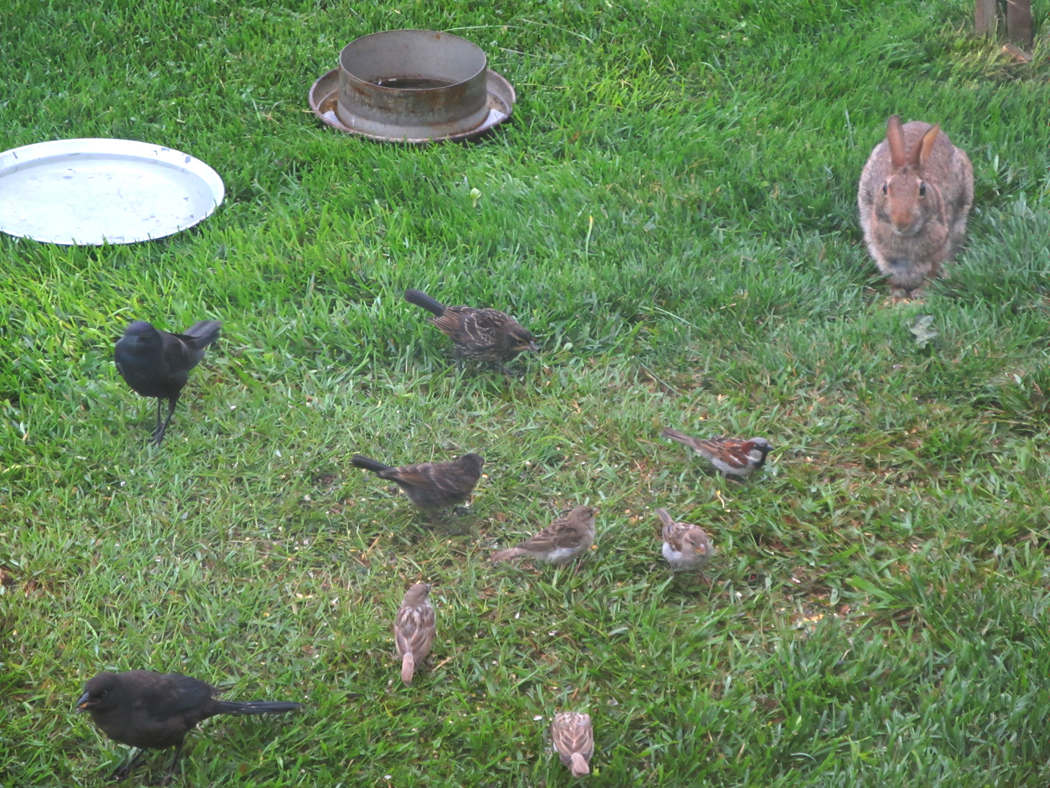
While I’ve been sitting around, resting in our sunroom since May, I’ve been observing the birds and wildlife in our backyard. The bird population, or lack of birds, around our place this week has seen a drastic change. Where have the birds gone? They’ve been around the feeders for months, but this week they seem to have abandoned the feeders. All the ground feeders are missing too. We always have huge amounts of grackles, red-wing blackbird's, starlings, and cowbirds. Most of those birds disappeared this week. They must know something we don't. 

We had many Orioles this summer, but they also abandoned us this week. I haven’t seen a robin for a couple of weeks now. The humming birds also left. They all seem to know that a change is in the air and it’s time to pack their bags and start flocking up for the journey south. They seem to travel better in large flocks. I’ve seen a lot of flocks darkening the sky this week.

Barn swallows have been very active as they swoop around the lawn snatching flying insects out of the air. Whenever somebody's mowing the lawn they circle the lawnmower as it kicks insects out of the grass. They really have a feast when the mower is busy. The killdeers are still around. I love to hear the call of the killdeers in the evening.

Mourning doves are still here picking up seed on the ground. They stay around all winter. There are 18 mourning doves eating under the feeder at this time. Along with the doves, we have all types of sparrows that stay around all year. A rabbit just joined them. Along with the birds and rabbits, sometimes a chipmunk stops by to fill its cheeks and take a load of seeds back to its hole in the yard.


The Cardinals showed up on the feeder this afternoon. The sun was shining and when it hit their feathers it produced a brilliant red color. They stay around all winter, just like the blue jays. we have all types of sparrows that stay around all year. We also have several types of woodpeckers.  
             
It’s great to sit in our sunroom and watch the comings and goings of the birds all year long. 


Its now a day later, and still very quiet around the birdfeeders. This morning a family of pheasants emerged from the hay field and strutted across our backyard. I’ve heard them calling from the fields and the grove of trees next to our house. It’s always nice to see them. As you can see, we have quite a variety of birds around our house. I’ve seen a few geese passing over, but they usually just pass by and don’t stop to visit. That will change later in the fall when there is corn on the ground for them to munch on.

We had a brief visit from a bald eagle one day when it dropped out of the sky and grabbed a chipmunk that was sitting beside the entrance to its home in the back yard. The eagle took off with the chipmunk hanging from its talons. That chipmunk won’t be dining under our bird feeders any more. Let that be a lesson to all of us while dining in the wild. Always be aware of your surroundings, lest you end up as part of the food chain.

*

Tuesday, September 1, 2015

Pretend Farmers and their Farm Toys

Across the Fence #563


There are two John Deere tractors in my office. I have a 1/16” scale model John Deere B made by Country Classic Models in Dyersville, Iowa. I also have a John Deere 50. Those are two tractors that are near and “Deere” to my heart! 

I spent a lot of time on those tractors when I was growing up. Not the ones in my office, but the real ones. They bring back a lot of memories. The only thing missing with the toy tractors is the sound. Just as a Harley Davidson motorcycle has that distinctive “potato, potato, potato” sound, the old John Deere tractors had the distinctive “putt, putt, putt” sound. You knew someone was hard at work when you heard that sound echoing across the countryside. I can still hear it now in my mind. I love that sound.

I guess I have a fondness and preference for John Deere tractors because that’s the only kind we had on the farm. 

I love Jerry App’s book, “Every Farm Tells A Story.” Jerry likes the old Farmall H they had on their farm. He claims the H was able to power their threshing machine when the neighbor’s John Deere B couldn’t handle it. Just like their neighbor and Jerry’s Pa, who had a friendly rivalry when it came to tractor preferences, Jerry and I have our own ongoing debate as to which is better. 

Since I played with John Deere toy tractors as a kid, drove real ones, and now have model ones in my office, I guess you know where my loyalties lie.

I have a picture of my brother, David, and I with some of our farm toys when we were young. A John Deere tractor with the man attached in the seat is shown. I’ve seen two of those tractors in antique stores with $750.00 price tags on them! I think ours probably ended up in the dump, or along with other discarded old “junk” to fill in the cistern when it was no longer used.
Me on left and David on right.

Also in that photo is a tractor with Mickey Mouse on it. I imagine that also found its way into some trash dump or the old sink hole on the “Hauge” farm. I wish I had those toys now to put alongside my other tractors.

The reason there are only John Deere tractors in the photo is because my father dealt with the John Deere dealership in Westby. They always had toy tractors and machinery for display and sale. I was fascinated with the toy machinery with moving parts. We had a manure spreader where the beaters even went around. 

What is it about toy farm machinery that delights “pretend farmers” of all ages? It’s the same with people who love toy trains. Is it because we can create our own miniature world and have a little control over it? That’s something we don’t always have in the larger world around us? I don’t pretend to have the answers. I just know I liked and still like farm toys. 

The National Farm Toy Museum is located in Dyersville, Iowa. It has 30,000 farm toys and displays! Lots of John Deere tractors and farm implements too! I’d have thought I’d died and gone to Heaven if I’d walked into such a place when I was young. I can’t even imagine what the National Farm Toy Show that’s held in Dyersville each fall must be like. Can you imagine attending a show with hundreds of exhibitors and venders and all those farm toys? Now you know how a mouse would feel if he found himself trapped in a cheese factory! 

I suspect some of the toy tractors you may find at the toy show, especially the antique ones, could set you back more than my father paid for the full size, working model of our old John Deere B.

My scale model of that tractor is detailed right down to the flywheel. I remember cranking and turning that thing to start the engine. It usually took several turns before it fired. Then some puffs of smoke erupted from the muffler on top of the tractor, and that familiar “putt, putt, putt” sound brought the tractor to life. At least with my toy model, I don’t have to worry about my hands getting caught as the flywheel takes off. Toy tractors and machinery are much safer than the real ones.

Maybe the reason we like toy tractors and farm machinery is that they’re ageless. We can have fun playing with them when we are young and displaying them when we get older. As children we play with them and dream of the day we can operate the real tractors and machines. As older adults, we display them on shelves in our offices and remember the days when we did operate them.

Farm toys were, and still are, an important part of life for so many of us. We’re all just a bunch of old country boys and girls at heart.

*