Sunday, November 15, 2015

The Cap

Across the Fence #574


As I prepared to leave the barn, I saw it hanging there, just inside the door. It was covered with cobwebs and dust… Dad’s old Pioneer seed corn cap. It hung there as if waiting for him to step back into the barn and put it on again. He had been gone for almost eight years at the time, and it had to be several years before he died in 2000 when he hung that hat on the nail where it had rested all those years. 


That old barn, that was once the hub of activity on the farm, stood empty. Its end was near. That’s why I was in the barn that day. I had decided to take some photos and document what had once been an active barn before it was gone. When I came across Dad’s old cap, I took several photos of it hanging near the ceiling on a large nail protruding from a faded, whitewashed timber. Then I left the barn and bolted the door behind me.

There’s something special about caps. Each cap tells a story and is a walking advertisement. They tell a lot about the person wearing it.

I’ve always been a cap person. I had quite a collection of caps before we moved back to Westby. I’d acquired them from numerous sources. Most had some special significance. People even gave me caps they thought I’d like. Our daughter brought me a cap from Graceland when she visited there. I was a big Elvis fan when I was young. I had long sideburns and my hair slicked back into a ducktail. That’s back when I still had hair.

I’ve got John Deere caps, of course. Is there any other kind of tractor? There were also Wisconsin caps, Norwegian caps, farm products caps, a Harley-Davidson cap, and an assortment of Vietnam vet caps.

In an attempt to simplify when we moved, I gave many of my caps away to Good Will and St. Vincent de Paul. I kept some of the special ones, and wouldn’t be surprised if my cap collection started multiplying again. I told “Pioneer Bob,” the Pioneer seed corn dealer in Westby, that I needed a green Pioneer cap like the one Dad left hanging in the barn. He gave me one.

Have you ever noticed that when you see someone without a cap, that always wears one, they look very different?

I had a friend, Dennis, a big, bear of a man, who always wore a cap. I asked him one day if he took it off when he went to bed. He said he did. I don’t care what he said, I still think he slept with his cap on and one eye open. He died of lung cancer several years ago and was cremated with his MIA/POW cap on. I felt better when I heard that. It wouldn’t have been right to send him off to the Spirit World without his cap!

For you non-cap people, caps are important. They make a statement to others about who we are. They aren’t just to provide shade for our balding heads, although that’s important too.

I wear my cap with the bill straight ahead and curved down on the sides. Some people keep the bill completely flat and straight across. Today, many young people wear their cap brim to the rear. You can’t tell if they’re coming or going. Gang members wear their cap with the brim to the left or right to designate their gang affiliation. When I see photos of young people from my father’s generation, I see a lot of caps cocked to the side. My father always wore his that way. There’s a photo of him in his baseball uniform with his cap cocked so far to the side, I don’t know how he kept it from falling off. Talk about attitude and making a statement.

Caps also seem to categorize us. When I lived in Madison, one of the businesses I did advertising for was Sub-Zero Freezer Company. One day when I arrived, there was a new, young woman at the reception desk. I was just about to tell her I was there for a meeting with Paul, the Marketing Manager, when she grabbed a package off her desk and handed it to me. I looked at it and saw it was a package for Badger Cab to pick up and deliver. She thought I was the cab driver. If I had walked in with a suit and tie on instead of casual clothes and a cap, I know she’d have treated me differently.

Yes, caps are important, especially those with a history. As I was driving away after taking those photos in the barn, I started thinking about Dad’s old Pioneer seed corn cap hanging there. Should I leave it behind and let it be destroyed with the barn? It would be a fitting epitaph for his old cap to be buried with the barn, just like my friend Dennis, going out with his cap on. After thinking about it for a while, I turned around and went back. I couldn’t leave it behind. I took the cap down from the nail, dusted some of the cobwebs off, and put it in the car. It now hangs on a nail in our garage. I think he’d like that…


knowing his old farmer cap still hangs on a corner of the land he worked and loved for all those years.


Friday, November 6, 2015

Veteran's Day-My Band of Brothers

Across the Fence #573


I’d like to recognize some veteran friends of mine this Veteran’s Day. We are truly a Band of Brothers. They’ve been here for me in various ways since they found out I have brain cancer.
Vernon County boys Leaving La Crosse airport  in June 1966 for Ft. Lewis, Washington, and then on to Vietnam. L-R: Ray Slaback, Howard Sherpe, Harlan Springborn, and Larry Skolos.

First of all, I’d like to recognize a bunch of friends that I served with. We were drafted at the same time in December 1965 and went through basic training together. After our advanced individual training we all came back together in the same unit with the 4th Infantry Division. We went To Vietnam on the same troop ship and ashore in the same landing craft. We were on many operations and ambush patrols together. In November 1966, we all survived the largest mortar attack of the war, up until that point, at our forward firebase. We fought to protect each other during the ground attacks that followed. Those kinds of experiences forge friendships that will last a lifetime.

Reunion at Veterans Day program at Westby H. S.  in 2010. L-R: Don Hanson, Howard Sherpe, Ray Slayback, Larry Skolos, and Harlan Springborn.

When they found out I had cancer, word quickly spread among the network of old 4th Division vet friends. They began calling to see if there was anything they could do for me.

Harlan Springborn from Westby showed up at the hospital the day of my brain surgery. He sat with Linda in the waiting room from 8:00 am until I was brought back to my room at 4:30 pm. He told Linda he wasn’t leaving until he saw the whites of my eyes! He’s visited me many times to see how I’m doing and even brings baked goods.

Larry Skolos from Viroqua is also in this 4th Division Brotherhood. He and his wife, Cathy, have visited and brought strawberries that they grow on their farm. She also brought bars she had made.

Ray Slayback called from Monroe. He lived in Readstown in Vernon County when we were drafted.
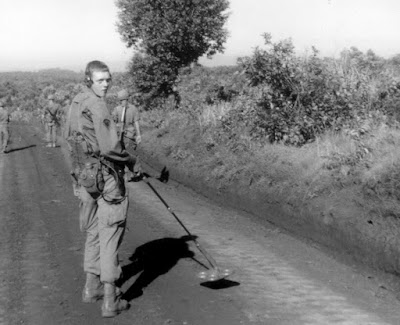
                                             Ray Slayback on a road clearing operation.

Don Hanson, who now lives in De Pere,Wisconsin, has called and e-mailed. Don is also fighting cancer and undergoing chemo treatments.

Howard Sherpe- left, Don Hanson-standing next to Howard- ready to leave on an ambush patrol.
The two men kneeling are gone.

Ken “Big Lee,” lives in California. He calls and e-mails. We spent a lot of time together on operations. Below, Ken "Big Lee" manning the M-50 on a road security operation. I rode shotgun behind him, watching his back.

Elmer Wischmeier from Sedalia, Missouri, calls and writes.

Harlan Springborn and Elmer Wischmeier


Harlan Springborn-sitting, and Elmer Wischmeier- in front, on an ambush  patrol.

That’s our band of 4th Division Brothers who spent some intense times together in Vietnam. They are still there, wanting to do whatever they can to help me. 

David Sherpe with his M-60 machine gun.


David Sherpe -2015.

I’ve got to thank my brother, David for coming from Cross Plains almost every week to mow our lawn and take me to clinic appointments. David was with the 9th Infantry in the Mekong Delta in Vietnam. When David couldn’t come, my other brother, Arden, mowed it.  My sister, Janet, was also there to help wherever needed. I thank them all. I couldn’t ask for any better brothers and sister. 

There are other veterans I want to recognize, who weren’t in our 4th Division Brotherhood.  I met them later and we became good friends. 

Lou Wagner

Also, Lou Wagner, my cousin-in-law from Colorado, stopped to visit on his trip to Kansas to see his kids and grandkids. Lou was with the 1st Cav in Vietnam.


Bob McCurdy from Door County was with the Riverine Forces in Vietnam. Bob and I have become good friends over the years. We share a love for wood craving and writing. Bob carved a bird and sent me. It's to watch over  and protect me as I battle this cancer. Bob has become a special friend and Vietnam brother.

                                                 Bob McCurdy and his buddies.
John Cotter
John Cotter, from Middleton, who was with the 9th Infantry, has become a friend and has sent me messages and story ideas. 


Tom Olson from Viroqua was a helicopter pilot in Vietnam. Like so many of us who ended up in the Vietnam vet Brotherhood, John was a Wisconsin farm boy too. Tom has had his own health problems lately. 
Above: Tom Olson flying his helicopter in Vietnam.


Tom Olson-at a reunion- in a helicopter he flew in Vietnam.


My veteran friends from the Madison area have been great.
Tom Deits
There’s Tom Deits who was with the 1st Infantry. Tom talked me into joining a vet’s writing group he had organized. He knew I liked to write. That group became known as The Deadly Writer’s Patrol. Tom has become a close friend, who has visited me and sent many cards letting me know he’s thinking of me.
                                                           Tom Deits


Steve Piotrowsi
Steve Piotrowski
Steve Piotrowski, who was with the 173rd Airborne in the Central Highlands, was also a member of the Deadly Writer’s Patrol. Steve and I were on the Highground Veteran’s Memorial Park board at Neillsville, Wisconsin for many years. 

Ted Fetting from Milwaukee, who served with the 9th Infantry, was also on the Highground board. 
Ted Fetting by helicopter at the Highground


David Giffey

David Giffey, from Arena, Wisconsin was with the 1st Infantry. David was also involved with The Highground and designed the peace dove effigy mound. The four of us spent many trips together from Madison to Neillsville and had many deep discussions about life and war. We served in different units in different parts of the country, but we had the shared experiences of operating with infantry units, and we were all Wisconsin farm boys. Even though we didn’t serve together in Vietnam, we are part of that Vietnam vet Brotherhood and have a close friendship. They’ve been there for me with messages, visits, and wondering what they can do for me. I tell them, “Your friendship is all I need.” When I was going through radiation and chemo treatments every day, I received a “Warrior Bracelet” from Steve. He made it with colored beads to represent the Vietnam service ribbon, and then attached items that represented my Vietnam service. There was a 4th Infantry Division logo, a combat medic badge, and a peace symbol. The clasps were shaped like the prows of a Viking ship, to represent my Viking warrior ancestry. Steve said I should wear it as I fought this new enemy I found myself up against.

That’s quite a group of Vietnam vet brothers. This Veteran’s Day, I wanted to recognize them and thank them for their friendship. 

I hope everyone will take time to reach out to veterans you know and thank them for their service.
*

Monday, November 2, 2015

Aprons, Pumpkins, Cell Phones, and Petting Zoos

Across the Fence #572


This column will be a conglomeration of several ideas.

Grandma Julia in apron.
Recently I wrote a column about grandma’s apron. Since I wrote that column I had some other ideas on what aprons would be today if every grandmother and mother had an apron. One thing I thought about was that things have changed a lot since those days. Everybody's carrying a cell phone now. I think the first thing we have to do with that apron is to install a small pocket that could hold grandma’s cell phone. Then instead of waving the apron when it was time to come and eat, she would just get out her cell phone and call whoever was out in the field and tell them it was time to come and eat. It’s not as primitive as waving an apron or towel and trying to get someone’s attention. I still prefer the old way of waving an apron. It just seems more personal. Not only that, but it means that if you ‘re out in the field doing something, you don’t have to carry your cell phone with you and anybody can get in touch with you anytime they want to. I thought it was nice to be out in the field alone, either driving on the tractor doing something like cultivating corn or tobacco. I loved operating the tractor on a field far from the farm buildings. It was about the only time you could be alone with your thoughts. I didn’t want to be interrupted by phone calls, and we didn’t have to worry about that out in the field where there were no phones. Although I don’t know who would have called me. I was never overburdened with phone calls from girls, or even my friends. We didn’t do a lot of phone calling, and if we did, we had to stand by the wall phone in the kitchen. Thinking back to those days, cell phones would have made it easier to have private conversations. Maybe we would have used a cell phone to call somebody then.
Sean looking for a pumpkin.
Another subject that I’d like to touch on at the end of this Halloween season. A lot of pumpkins are sitting around the countryside still waiting for someone to come along and choose them. Pumpkins of every size wait patiently for someone to come along and transform them into Halloween jack-o-lanterns. Carving pumpkins has been a tradition in our family since the kids were young. We always had four pumpkins of varying sizes… larger ones for Linda and me, and smaller ones for our children, Erik and Amy. Later, I had to carve one for our dog, Toby, too. Erik and Amy would help with deciding what kind of face they wanted carved on their pumpkins. They also helped pull the brains (insides) out of the pumpkins. It’s OK, Halloween is supposed to be a little scary and gross. A pumpkin is just a pumpkin until you carve a face into it. Then it takes on a personality of its own, depending on the type of face you carve, friendly and inviting, or scary and menacing. But, a pumpkin doesn’t really come alive until you put a candle inside and let the light shine from within. It’s the same with stained glass windows, and people too.

I imagine most of the candy has been consumed by now, although some kids get enough to last until next season.
Petting the animals.
During the Halloween and Thanksgiving season many of the farm produce places decorate their farms with all kinds of things for young children to have fun on. We've gone with Amy, Tim, and our grandson, Sean, to Peck’s Farm Market near Spring Green. They have everything you can imagine There’s a petting zoo with all kinds of animals to feed. There are old tractors to climb up and sit on. I think Sean sat on every tractor in the place. It’s a great place for kids to enjoy the outdoors and get acquainted with animals.

I know Sean is also looking forward to their Halloween party at Day Care. They get to dress up, have a party, and have a parade around the block. Hopefully it will be a nice day. That evening they have Trick or Treat time. The prediction is rain and cold. Pretty much the same weather we often had for Halloween when Erik and Amy were young. Whatever the weather, they are making memories that they can write and tell about in the future.

*

Tuesday, October 27, 2015

Happy Hollow-een

Across the Fence # 571


How many of you remember “The Legend of Sleepy Hollow” by Washington Irving? I remember watching Walt Disney’s animated version on The Wonderful World of Disney in the 1950’s when I was young. The other day we were driving around, when I started noticing all the roads with Hollow in the name. It brought back memories of Sleepy Hollow.
It had the gangly schoolteacher, Ichabod Crane as the main character and was narrated by Bing Crosby. It also had a dark forest and the scary headless horseman. I don’t remember a lot of details about the story, but I know it was exciting and frightening.

I remember the headless horseman chasing Ichabod as they rode through that dark forest, with the branches of the trees reaching out like skeletal fingers, trying to grab Ichabod—Pretty scary stuff. A perfect story to remember as Halloween approaches.

There’s always something magical about Disney animation, and when you add Bing Crosby narrating and singing, you have the makings of a wonderful film. Ichabod was the underdog in the story. He was everything that we associate with the non-hero type of person. I think most of us like to stick up for the underdog and see them win. We see ourselves as underdogs too, and can relate to them.


I prefer the Disney animated films to the horror films, usually associated with Halloween. Even before I went to art school, I wanted to be an animator for Walt Disney Productions in California. I even wrote a letter to Walt when I was still in grade school, telling him I hoped to work for him some day. I never did hear back from him. I suspect he had more important things to do, and received many letters like that every day. It’s probably a good thing I never headed off to California to seek employment with Walt, or my life would have been completely different and I wouldn’t be writing this story now. Life seems to offer us paths that we can choose to travel, but just as Ichabod found out, some of the paths we choose can be pretty scary at times.

Halloween has changed a lot in my time. When I was young, I don’t remember going trick or treating. When you lived in the country, you couldn’t just walk door to door and collect more candy than you could eat in a month, as kids do today. In our case, our father would have had to drive us from place to place. He was busy milking cows and we were busy helping with the chores. My mother didn’t drive. 

I think our Halloween celebration happened in our one-room country school, where we had a party on a day close to Halloween. We bobbed for apples, and had a fish pond where a sheet was strung up and we took turns fishing. The pole had a line attached to it with a clothespin on the end. When you put the line over the sheet, older kids behind the sheet attached a small prize. They pulled on the line so it felt like you’d caught a fish, and you brought up your prize. I don’t remember what the prizes were, but they were probably pretty simple. The dressing up we did was called Hobo Day. I think that was all part of our Halloween celebration. 

When our kids were young, they always went trick or treating around our neighborhood. Linda or I went with them and stayed on the sidewalk while they went up to each house. One of us stayed home to dish out the candy to kids who came to our house. We just went to houses where we knew the people, not to every house within a mile radius, as some kids seemed to do. One year I got into the act too. Linda’s brother, Lon, and his family, lived in Middleton. We drove to their house, where I put on a mask and wore an old trench coat. When the kids rang the doorbell, I knelt on my knees between them. When they opened the door, we all said “trick or treat.” But the trick was on me. They knew exactly who that big kid was between Erik and Amy. “Aren’t you a little old to be trick or treating?” I guess I should have stuck to tipping corn shocks and outhouses. I’ve heard tell, people used to do those activities on Halloween.

Halloween can also be a cold time of year. Many times it’d be raining and very cold. The kids would be all dressed up in their Halloween costumes and then have to wear a coat over the top to go trick or treating. That kind of defeated the whole purpose of dressing up. They could just as well have dressed up in long johns, heavy parkas, mittens, and a ski mask to cover their face, and gone door to door that way. At least they’d have been incognito and warm.
They also had Halloween parties at their school, except for a couple years, when it was decided by the powers-to-be in Madison, that it was not politically correct to dress up with masks, because some people might be offended or frightened. At least Halloween was later reinstated, so the kids could enjoy the occasion and have some fun memories to look back on too. 

Happy Hollow-eening everyone! 
*

Wednesday, October 21, 2015

Corn Shocks Are Fall to Me

Across the Fence #570


Corn shocks stand like lonely sentinels, guarding the last memories of a vanishing lifestyle. A backdrop of changing colors in the woods bordering the cornfield signals the arrival of fall. A flock of geese passing overhead completes the picture as they talk among themselves. It’s fall and the harvest has begun.


The sight of corn shocks and pumpkins in a field represents what the fall season is to me, in the pictures in my mind. Today, corn shocks are as scarce as hen’s teeth around the countryside, unless you head for Amish country. We have a large Amish community within a few miles of Westby. As we drove around the area last weekend, we were once again treated to the sight of fields filled with corn shocks. It was a welcome sight and brought back memories of how farming used to be on most farms.

Today I can watch monstrous combines going through the fields around us, day and night, as they clear huge fields of soybeans in a fraction of the time it used to take. Soon they’ll be stripping the cornfields bare, shelling the corn as they go, and filling semi trucks that haul it from the fields. Today, fall harvesting is big, fast, and in many ways impersonal.

Many of you can still remember when small farms of one hundred acres, or less, were the norm. Corn shocks were not a novelty in those days. It wasn’t shocking to suddenly come across a field filled with them. What would us young Prairie Ghosts have done on Halloween if we couldn’t have tipped over a few corn shocks? I’m not saying we ever did, but there’s something about a corn shock that attracts young boys and shouts out, “Tip me over!”

Another thing I remember about fall and corn harvesting was helping dad clean up the field of corn that had escaped the corn picker. We used a curved husking peg or knife that was strapped to the palm of a heavy, leather strap that fit around our hand. We used it to rip open the husks, break off the corncob, and throw it in a wagon. In those days, nothing was wasted. Perhaps some of you can remember when you picked whole fields of corn using the husking peg and threw the ears against a “bang board” on a wagon pulled by horses. I have several husking pegs in case I ever get the urge to clear a cornfield by hand.

I also remember harvesting as being a neighborly event, with lots of good food involved. It was a time when neighbors got together and helped each other with the harvest. Meals were looked forward to and every farmer knew who the best cooks in the neighborhood were. Sometimes long tables and chairs were set up on the lawn because there wasn’t enough room in the house. The women slaved over the hot cooking stove all day preparing the meals. There were large bowls of mashed potatoes, rich gravy, big platters of meat, home-grown vegetables, pickled beets, cole slaw, home-made bread and lefse, topped off with fresh pie and steaming cups of coffee. My mother was known for her great meals and pies. No one ever went away hungry. The meals, shared by the neighbors, were a big part of the harvest. I suspect the men doing the harvesting today, and running those big combines and semis on corporate farms, are missing out on the best part of the fall harvest… the wonderful meals and neighbors working side by side as they helped each other.

When I feel the brisk winds of fall, as darkness begins to envelope the land, I remember sitting in an empty wagon at the end of the cornfield. It’s dark and cold. The stars shine brightly overhead in the clear, crisp sky. The light from the tractor makes strange, scary shadows dance among the corn stalks. The air is filled with the distinctive “putt-putt-putt” of the idling John Deere B tractor. In the distance I see the lights of the corn picker coming through the corn stalks. I hear the hum of the machine as it severs the stalks, and the continual “clunk, clunk, clunk” of ears of corn landing in the wagon box. The corn picker finally reaches us. Among the sounds and lights from the tractors and corn picker, there’s a flurry of activity as the full wagon is exchanged for the empty one. 
Throw in some snowflakes dancing in the lights, and it becomes a magical scene.
 When a wagon was full, we hauled it from the field to the corncrib, where we shoveled the corncobs into the crib. It was heavy, hard work, especially when I was younger. Now most corncribs are gone, along with one and two row corn pickers. Gravity boxes replaced the old wood wagons, and now large trucks and semis are replacing the gravity box. Those huge combines have replaced the need for neighbors to get together and help each other with the harvest.

All this mechanization has allowed farms to get bigger and the harvest go faster, with fewer people involved. But to me, fall harvest is still represented by those shocks of corn, standing tall and reminding us of another time and place, where neighbors even talked across the fence.
*

Tuesday, October 20, 2015

Coffee Boycott

Across the Fence #569


It’s been a long time since I’ve visited the Coon Ridge Family Restaurant and Truck Stop. Things were jumping as usual the other day when I stopped in. It’s located near the edge of town at the intersection where two roads cross. Each road leads to no place in particular, unless of course you live along one of those lazy country roads.
The Morning Breakfast Gang was holding court at the only round table in the restaurant, as they do every morning. They keep trying to solve the problems of the world. Most folks round’ here think it’s rather pointless, since most can’t even solve the problems in their own back yards. I can’t report that they’ve ever solved a single one of the world problems they’ve debated, but like people everywhere, they certainly have all the answers, at least in their own minds. I’ve got to admit, I’ve taken part in those debates too and put my two cents worth in. Every town needs a family diner where the locals can congregate and debate the issues of the day.

The Wednesday Breakfast Gang in Madison, back when I still lived there. Several of  them have moved on to the big round table in the Great Unknown. The rest of us have seen healthier days.

When Thoreau said the majority of men live lives of quiet desperation, he must have been thinking of the guys like me who hang out at the Coon Ridge Family Restaurant and Truck Stop. 
However, the name is a bit misleading. It’s not really a truck stop unless you count the assortment of pickup trucks parked outside on any given day of the week. Tiny Olson thought it sounded like a good name when he opened the restaurant. He always heard people say that you should eat where the truckers eat, because they know where the food is good. So he added Truck Stop to the name, thinking it would attract more people. What attracts the crowds to the restaurant isn’t the name. It’s the only restaurant in town, so it isn’t like they have a choice! 
In all the years the restaurant’s been open, no one’s ever asked Tiny where all the big rigs and truckers are. My guess is that no one really cares. They just want a place where they can swap lies and solve world problems over a fifty-cent bottomless cup of coffee. Yes, you heard me right, coffee is still only fifty cents at the Coon Ridge Family Restaurant and Truck Stop. That includes endless refills. 
About a year ago, Tiny got sick and tired of all the boys drinking up his coffee every morning and he raised the price up to seventy-five cents a cup. That still included endless refills at no charge. Well, the gang got ticked at Tiny for trying to rip them off and they all boycotted the place. They started driving down to Coon Creek and hanging out at Joe and Dot’s Diner. The coffee wasn’t near as good and the drive took twenty minutes each way on a hilly, winding road. That easily ate up much more than twenty-five cents in gas, so they certainly weren’t saving any money. But it was the principle of the thing. A determined, ornery, cheap bunch of Norwegians trying to make a point is not a group you want to be on the wrong side of. 
Word quickly spread around Coon Ridge that Tiny had raised his prices and that the Morning Breakfast Gang was boycotting the place. Loyalty to a hometown business doesn’t go very far when twenty-five cents is at stake and feathers have been ruffled. 
In the past, finding a table or booth for breakfast at the Coon Ridge Family Restaurant and Truck Stop was like looking for hen’s teeth. And Heaven forbid if some outsider stopped in and sat at the wrong table. That upset the apple cart for the rest of the day, especially if the Morning Breakfast Gang didn’t get their round table. Their icy stares at the intruding parties could have sent icicle daggers through their hearts. But during the boycott, the tables and booths sat empty except for the outsiders stopping by for breakfast on their way through Coon Ridge in search of the Northwoods. 
The boycott was driving poor Tiny out of business. After two months of everyone driving to Coon Creek to eat, Tiny waved the white dishtowel of surrender and lowered the price of coffee back to fifty cents. The war was over. He hand-printed a big sign with magic markers and hung it in his window for all to see, “Coffee–Only Fifty Cents!”
The next morning, the restaurant was overflowing again as all the regulars returned. They talked about holding out for a couple extra days just to put a little scare into Tiny and teach him a lesson or two, but with twenty-five cents involved, they didn’t see any sense in wasting more good money on bad coffee and extra gas. So the whole gang is back and holding court at the round table as usual each morning.
They still think they have all the answers to solve the problems of the world, if someone would only listen to them. But, nobody does. At least in their own minds they managed to solve a major local crisis – seventy-five cent coffee. And they won. 
It looks like the taste of victory has gone to their heads. Now the boys are talking about doing something about the high price Tiny charges for a piece of pie during their mid-afternoon coffee get-togethers. They think a dollar and a quarter for a piece of pie, free coffee included, is way too much to pay.
Stay tuned. This could get interesting.
*

Tuesday, October 6, 2015

Silo Filling

Across the Fence #567


Recently we were driving behind a tractor pulling a chopper wagon full of silage. The wind was blowing loose silage through the air, leaving a trail of it on our windshield and the road. The sweet smell of silage brought back memories of silo filling. I don't see many silos being filled these days. farming has changed. 

We were always in school when the silo fillers came to chop the corn and blow it up into the silos. We’d hurry home from school so we could get in on some of the adventure. Before we could start filling, the silo doors had to fitted into place and locked, to hold the silage in. You started at the bottom and worked your way up, securing each door as you climbed up the narrow chute. It was also fun watching the men put the blower in place and attach the pipes. They used a rope to haul the pipes up alongside the silo and hook them together. The final piece was the curved pipe that went into the silo.


When the full wagons started arriving from the cornfields, the action started. After the wagon was emptied, we used the John Deere 50 to take the empty wagon back to the field and exchange it for a full wagon.

When we got to haul the wagons from the field to the silo we thought we had been promoted to the major league. It was fun, but scary too. It was tricky pulling the big chopper wagon filled with silage alongside the blower and stopping in the right spot. 

After the wagon was in place, we pulled the silage from the back of the wagon into the auger, using curved forks. The blower then sent the silage rattling up the pipe and into the silo. That was a dangerous job. Many farmers have lost arms and legs when loose clothing got caught in the spinning augers and pulled the farmer in. It’s easy to see why farming is such a dangerous occupation. You’re always working around moving parts that can quickly entangle and harm you. Maybe it’s that sense of danger that added to the silo adventure when we were young.

As it got dark, lights from the tractors created a shadow-filled surreal world. It was dark in the silo as we climbed up the narrow chute to put in new doors and adjust the pipes. We had only a flashlight to light our way and help see what we were doing. One of our silos didn’t have a roof covering it. When you looked up, you saw a round circle of black filled with stars. It was like looking through a gigantic telescope at the evening sky. The reason we kept working after dark was that we had to get the corn in fast so the people who owned the harvesting equipment could move on to the next farm and get their corn harvested. There wasn’t any time to waste.

Now I watch huge combines going through a field taking many rows at a time, while a large truck drives alongside and the silage is blown into the truck. When the truck is full, an empty truck pulls alongside and away they go again, with hardly a pause in the action. They can clear a large field in a very short time.
The corn on the fields of the back forty behind our house, disappears faster than Rolaids at a hot chili eating contest. Times have sure changed since the days of a one-row picker pulled behind a tractor. We thought things were really changing when we saw the first two-row picker mounted on the front of a tractor. 

I don't think many farmers climb up into the silo anymore either. Now silage is stored in concrete bunkers or those long, white, plastic “worms” you see around farms.    
                           
Harvesting corn is much more efficient these days, but I still like the magical world I still see, hear, and smell that lives on in my memories as I relive those days of helping fill silo after we got home from school. Eventually the night sky was filled with stars as we continued working into the night with our only lights provided by the tractors.

Besides the silo filling, there were chores to be done and cows to be milked. David and I usually ended up with those jobs while Dad kept driving tractor and hauling wagons from the field to the silo. We would have preferred doing the driving and unloading of wagons, but we weren’t given a choice. By the time we finished milking it was time for bed. Morning came all too soon. Then it was up and help with chores before heading off to Smith School. We usually walked the mile to school along Hwy.14. We joined neighbor, Sharon Midtlien first, and then hooked up with Beverly and Donna Jasperson. The five of us walked together, to and from school, almost every day. When there was silo filling to do, we walked a lot faster, so we could help haul and unload the wagons.The smell of silage brings back a lot of memories.

*